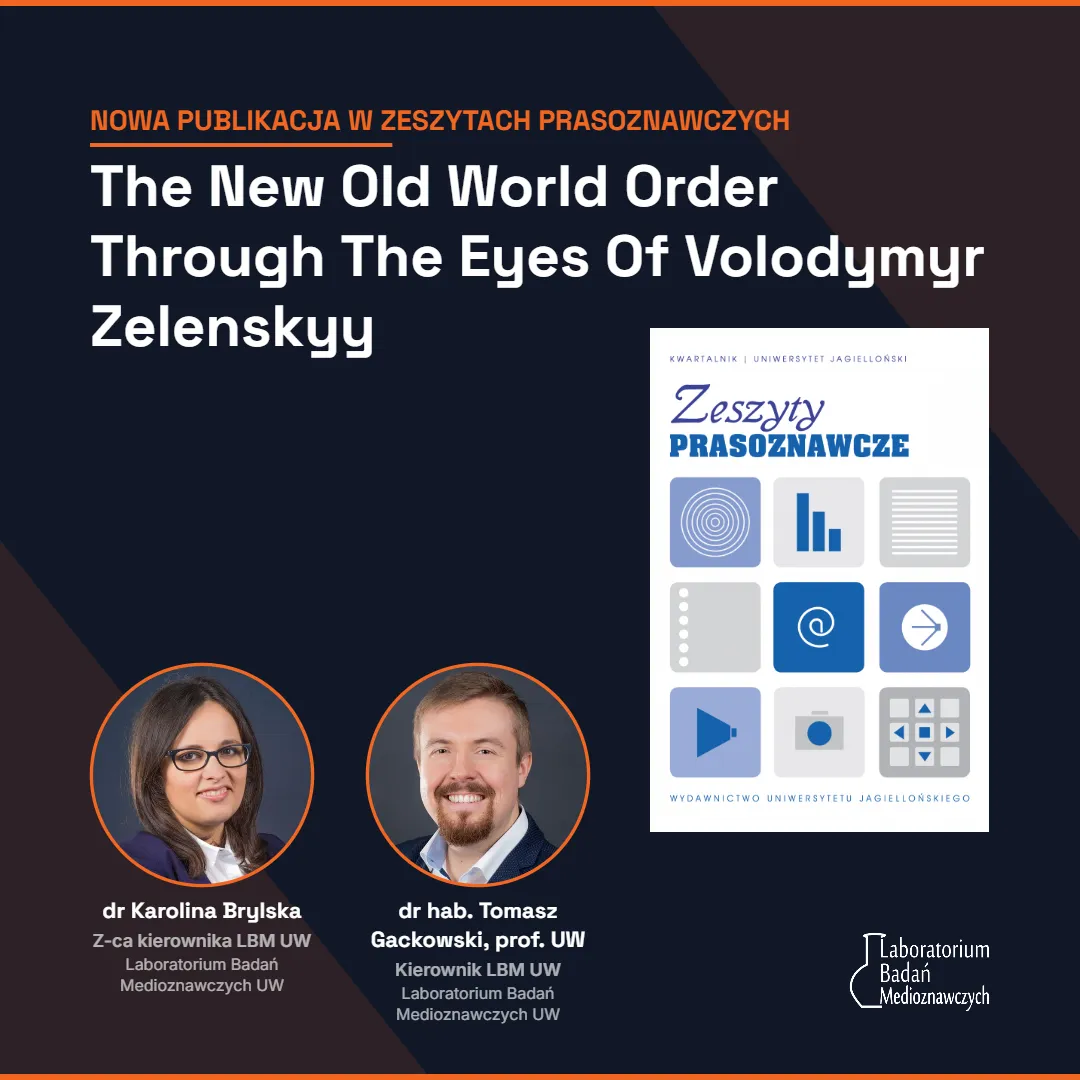
The paper analyses the rhetorical strategies employed by Ukrainian President Volodymyr Zelenskyy in 22 speeches delivered in March 2022, at the onset of the Russian invasion.
Zelenskyy presents Russia as the aggressor and Ukraine as a defender of democratic values. Using textual coding in QDA Miner, the study examines the balance between the “politics of hope” and the “politics of fear”.
The analysis also highlights a dichotomy between the global democratic community and Russia. The speeches combine traditional and modern elements of war propaganda to mobilise international solidarity and support for Ukraine.
The majority of Poles expect clear restrictions on social media - both with regard to adults and children - according to our latest nationwide CATI survey, conducted on 20-24 April 2026 by the Laboratory of Media Studies at the University of Warsaw in cooperation with the Institute of Journalism, Media and Social Communication at the Jagiellonian University.
The study involved 4,530 adult respondents.
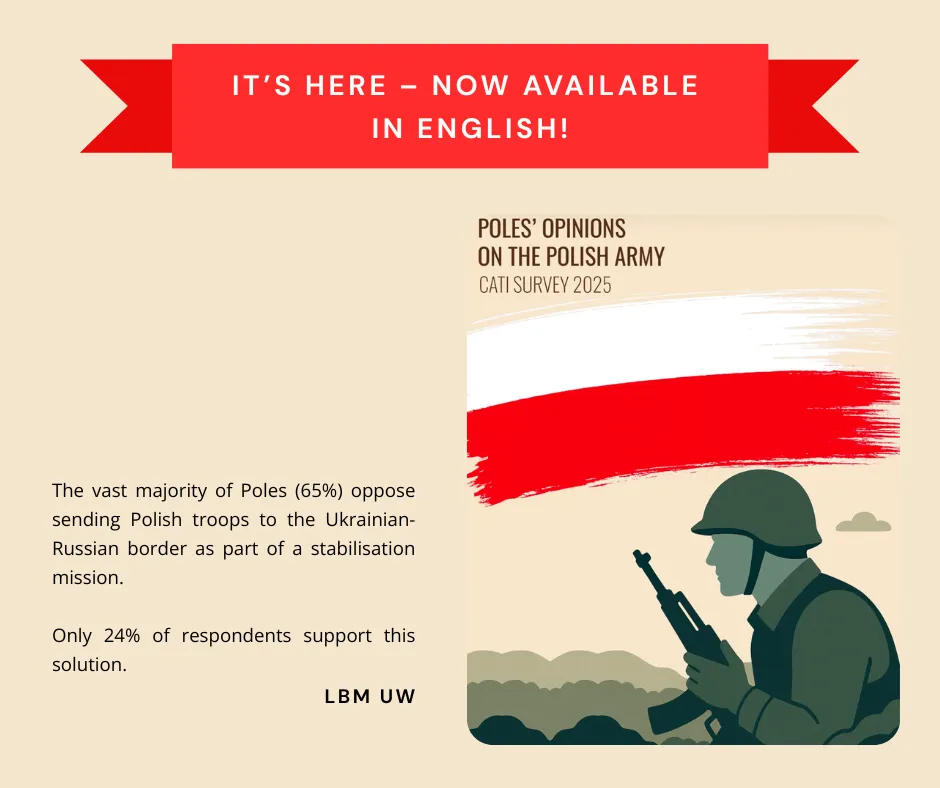
The report is now available in English! We encourage you to explore the findings and expert commentary.
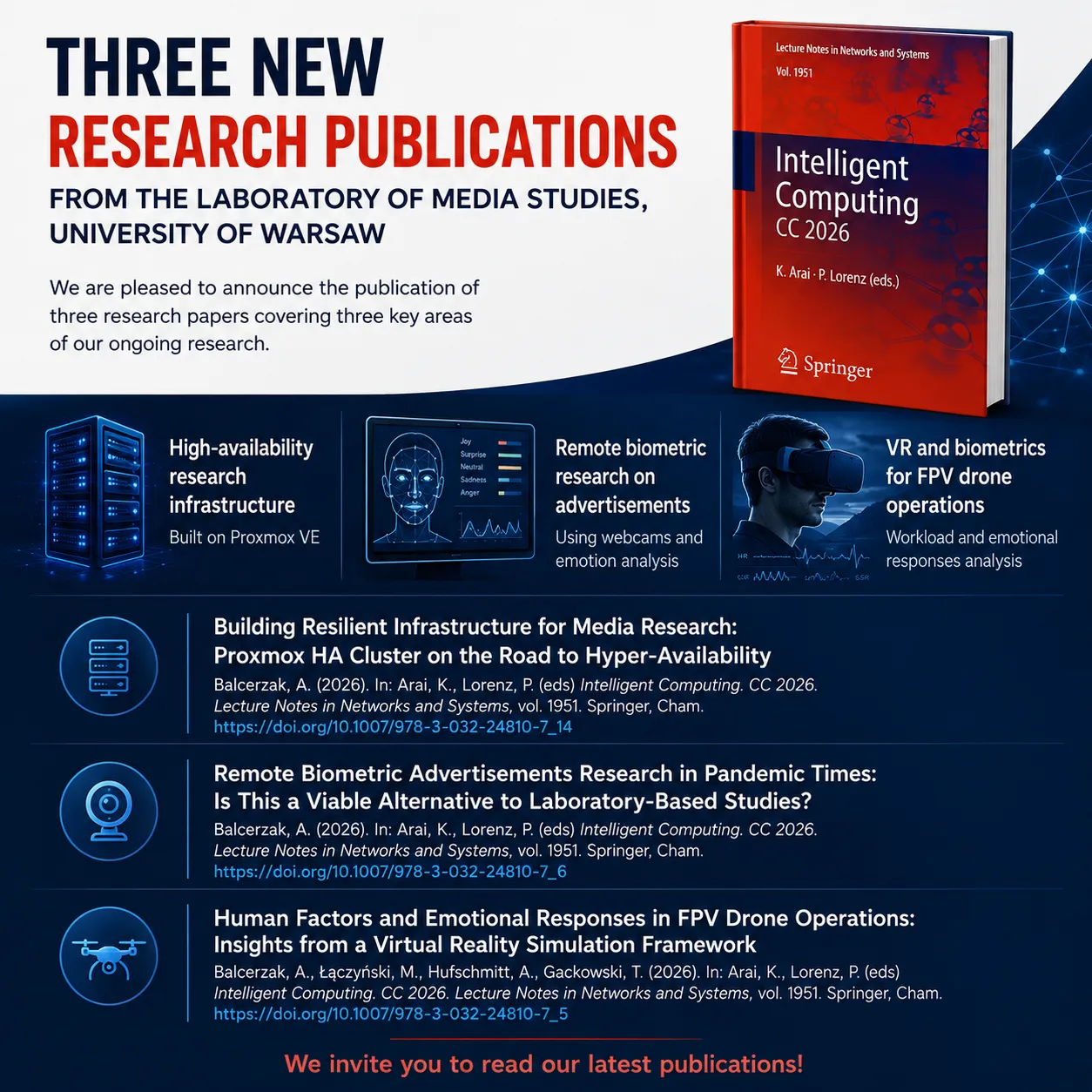
We are pleased to announce the publication of three research papers authored by researchers from the Laboratory of Media Studies, University of Warsaw.
The publications cover three distinct research areas developed within the Laboratory. The first paper presents the design and implementation of a highly available research infrastructure based on Proxmox VE, focusing on solutions that ensure reliability, scalability, and continuity of research services. The second paper examines the feasibility of conducting remote biometric studies on advertisement perception using webcams and emotion recognition technologies as an alternative to traditional laboratory-based experiments. The third publication explores the use of virtual reality and multimodal biometric measurements to investigate the workload and emotional responses of FPV drone operators.
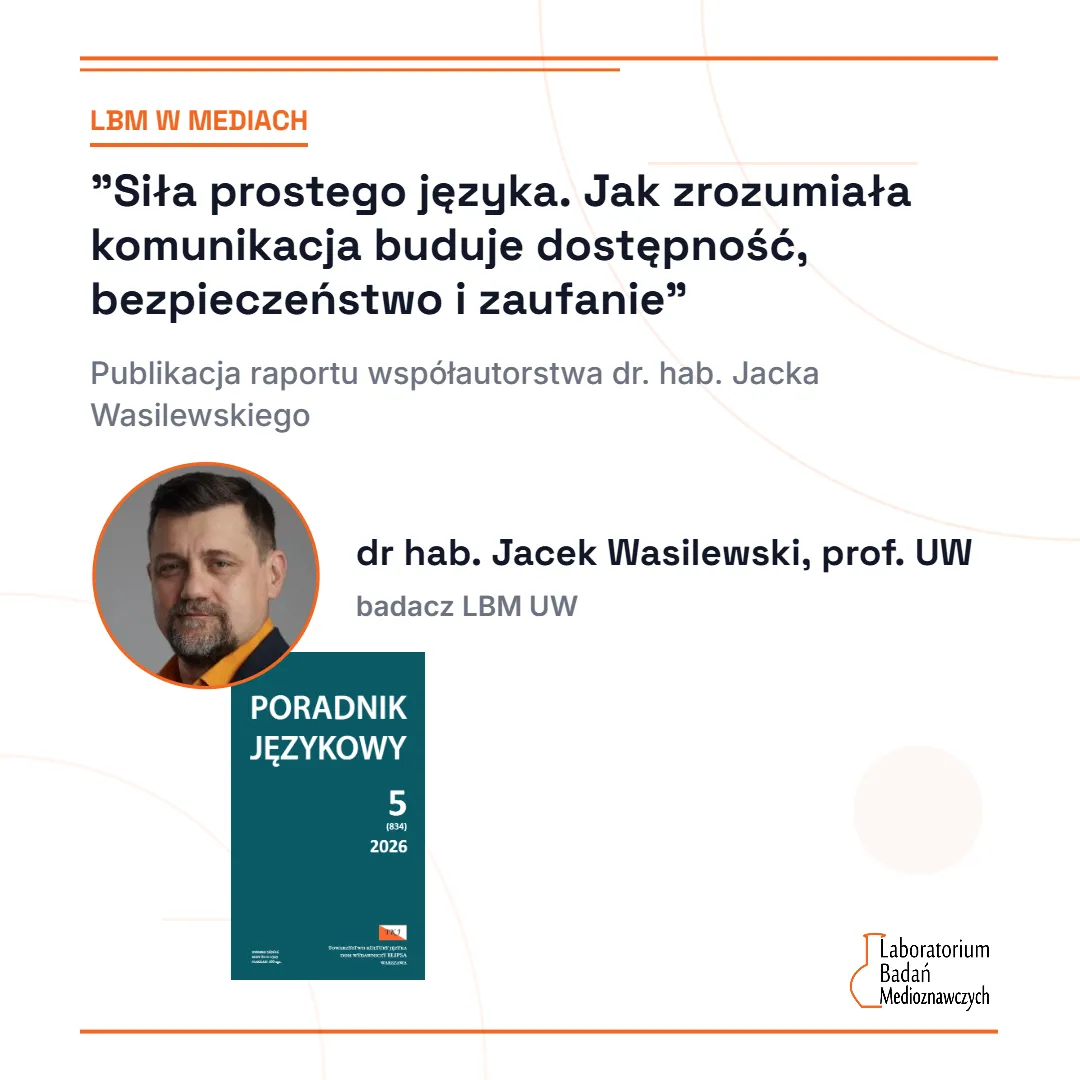
How does simple language build accessibility, safety, and trust? In July 2026, "Poradnik Językowy" (Volume 834, No. 5 2026) published a report by a team of researchers led by Dr. Jacek Wasilewski.
The team examined how simple and understandable language affects the perception of texts by neuroatypical and neurotypical individuals.
Why do even well-informed parents sometimes have doubts about vaccinating their children?
Whom do they trust, and how do they make health-related decisions in the age of disinformation?
We recommend a new article published on the University of Warsaw Science News Service, based on research conducted by members of the LBM at the University of Warsaw - Anna Mierzecka and Marcin Łączyński.
The article shows that decisions concerning vaccination are far more complex than a simple division between “supporters” and “opponents” of science. Emotions, personal experiences, and the ways in which people consume information in digital media all play a major role.
The publication follows a presentation delivered at ACDSA 2026 – International Conference on Artificial Intelligence, Computer, Data Sciences and Applications, held on February 5–7, 2026, in Boracay, Philippines under IEEE patronage.
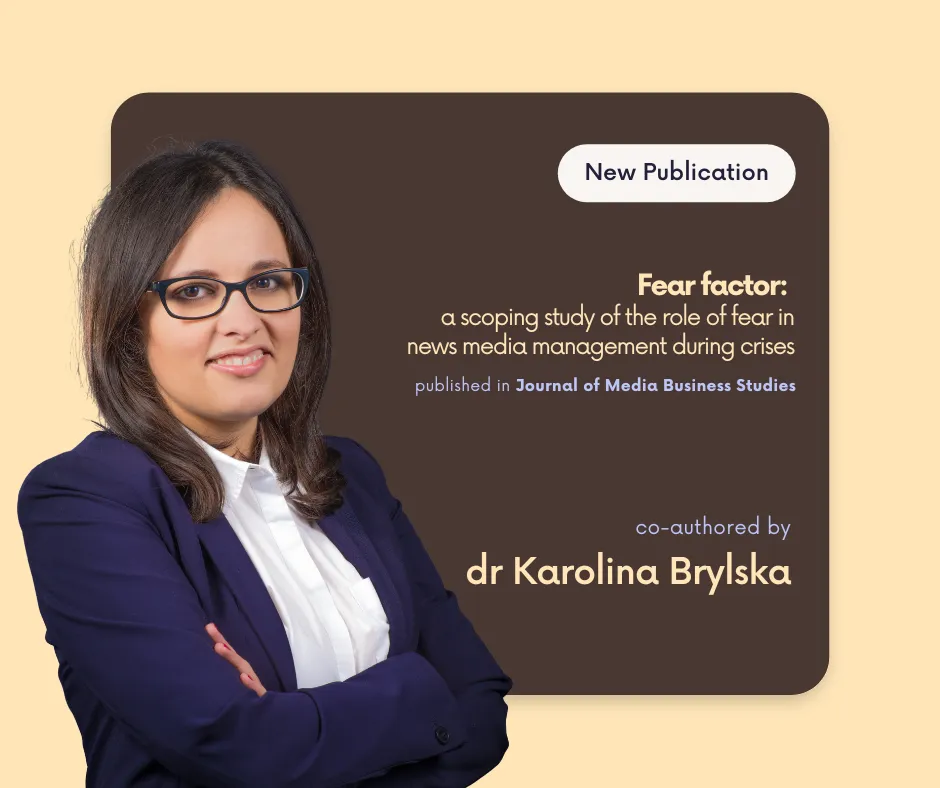
We are proud to announce that Journal of Media Business Studies has published an article co-authored by dr Karolina Brylska!
The publication is titled: Fear factor: a scoping study of the role of fear in news media management during crises.
Congratulations, and we warmly encourage you to read the full article.
Nel, F. P., Bernhard, M., Brylska, K., Waschková Císařová, L., & Sidyk-Furman, D. (2025). Fear factor: a scoping study of the role of fear in news media management during crises. Journal of Media Business Studies, 1–32. https://doi.org/10.1080/16522354.2025.2593761
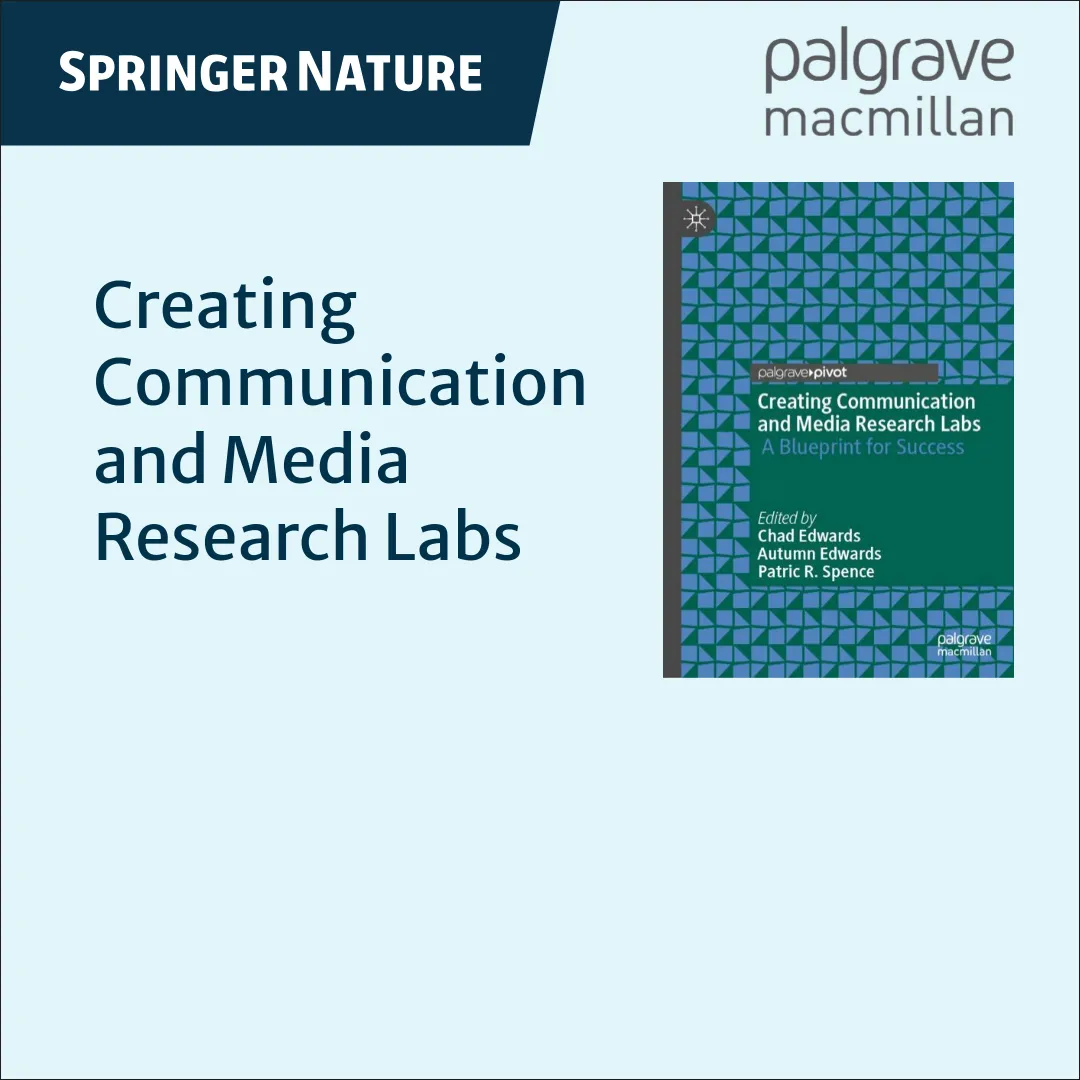
We are pleased to announce the publication of a book dedicated to the creation and operation of media research laboratories - Creating Communication and Media Research Labs: A Blueprint for Success. This is the first publication to focus not on research outcomes, but on the processes and practices behind establishing such labs.
The volume, published by Palgrave Macmillan, includes our chapter: “The Laboratory of Media Studies (LMS): The Lab of Social Narratives, Opinions, Behaviors, and Experiences”, authored by dr Karolina Brylska and prof. Tomasz Gackowski.
We are proud to announce that a conference paper by Adam Balcerzak and Julia Kwiatkowska has been published by Springer!
The publication is titled: “Balancing Beauty and Usability: A Comprehensive Evaluation of Awwwards-Winning Websites” and appears in the volume Digital Interaction and Machine Intelligence (MIDI 2024), part of the series Lecture Notes in Networks and Systems, vol. 1636, edited by C. Biele et al.
We’re excited to share some great news - a new book has just been published – “Knowledge – Communication – Action. Media Practices in a Digitalized World”, edited by prof. Agnieszka Hess, prof. Maria Nowina-Konopka and prof. Weronika Świerczyńska-Głownia.
The volume also features a chapter authored by members of our team - Tomasza Gackowskiego, Anny Mierzeckiej, Marleny Sztyber-Popko and Marcina Łączyńskiego: : “Between the Fear of Intelligent Machines and Trust in New Technologies: Perceptions of Artificial Intelligence in Public Opinion Research”.
We are delighted to share that Marcin Łączyński has become a co-author of the book “Adaptation of Residential Estates to Climate Change”, published by SGGW.
This is an important, innovative, and practical guide for everyone who wants to actively counteract the effects of climate change in their surroundings – from residents and young people to community leaders.
We are proud to announce that Journal of the Association for Information Science and Technology has published an article authored by prof. Anna Mierzecka and Marcin Łączyński!
The publication is titled: "Parents information behavior: Typology of vaccine attitudes in the context of information source use”.
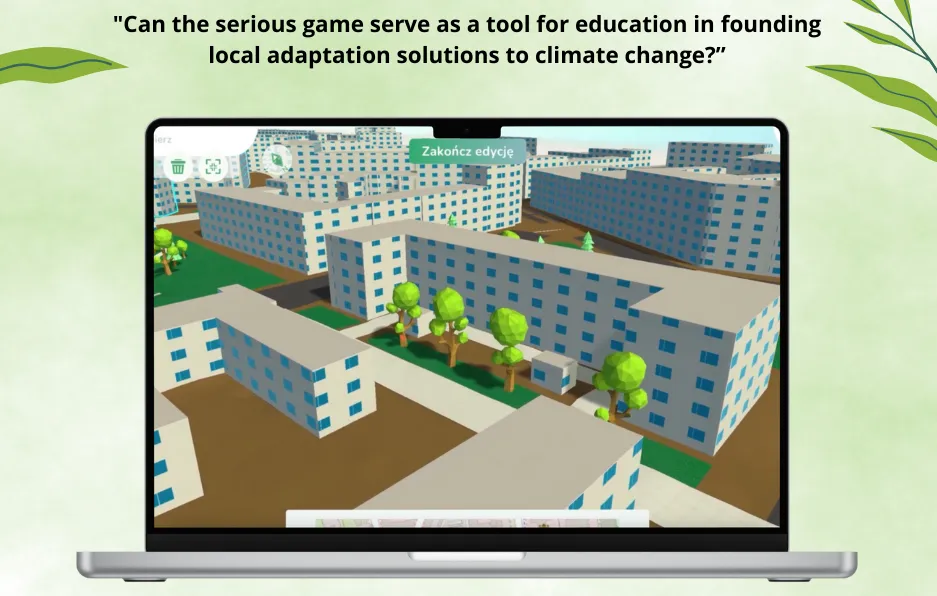
We encourage you to read the publication co-authored by Marcin Łączyński – "Can the serious game serve as a tool for education in founding local adaptation solutions to climate change?"!
Kuchcik, M., Łączyński, M., Cieszewska, A., Adamczyk-Jabłońska, J., Giedych, R., Maksymiuk, G., & Pusławska-Tyszewska, D. (2024). Can the serious game serve as a tool for education in founding local adaptation solutions to climate change? Geographia Polonica, 97(4), 485-498. https://doi.org/10.7163/GPol.0289
We encourage you to read the publication co-authored by prof. Tomasz Gackowski – "Effects of Over-Time Exposure to Partisan Media and Coverage of Polarization on Perceived Polarization"!
Heseltine, M., Clemm von Hohenberg, B., Menchen-Trevino, E., Gackowski, T., & Wojcieszak, M. (2024). Effects of Over-Time Exposure to Partisan Media and Coverage of Polarization on Perceived Polarization. Political Communication, 1–22. https://doi.org/10.1080/10584609.2024.2423093
We encourage you to read prof. Anna Mierzecka’s publication — "Academics’ information needs from the librarians’ perspective: A study of the research community of practice"!
Mierzecka, A. (2025). Academics’ information needs from the librarians’ perspective: A study of the research community of practice. The Journal of Academic Librarianship, 51(1), 103004. https://doi.org/10.1016/j.acalib.2024.103004
We invite you to read dr Karolina Brylska’s publication — "Who are Physicians Talking to on Social Media? Needed Data Literacy and Visual Literacy of the Assumed Audience(s) of COVID-19 Vaccination Posts"!
Brylska, K. (2024). Who are Physicians Talking to on Social Media? Needed Data Literacy and Visual Literacy of the Assumed Audience(s) of COVID-19 Vaccination Posts. In: Kurbanoğlu, S., et al. Information Experience and Information Literacy. ECIL 2023. Communications in Computer and Information Science, vol 2042. Springer, Cham. https://doi.org/10.1007/978-3-031-53001-2_8
We are proud to announce that The Journal of Academic Librarianship has published an article authored by Prof. Małgorzata Kisilowska-Szurmińska, a long-time collaborator with LBM! The publication is titled: "Artificial intelligence in academic libraries – a tool, a collaborator, an adversary? A Delphi study of university librarians in Poland".
Congratulations, and we warmly encourage you to read the full article:
We are proud to announce that Res Rhetorica has published an article authored by dr Karolina Brylska!
The publication is titled: “Fight for historical truth or political gameplay? Strategic narratives in Polish TV news coverage of the 2018 Polish–Israeli diplomatic crisis”.
Congratulations, and we encourage you to read the full article:
We are pleased to announce that a new article co-authored by Professor Anna Mierzecka and Professor Małgorzata Kisilowska-Szurmińska has been published in the prestigious journal Information Research – an international electronic journal, under the title Public library services for migrants in national government policies across eight European countries: a comparative analysis.
We are delighted to announce that Games and Culture has published a new article by Tomasz Gackowski, Marcin Łączyński and Michał Gołębiowski.
The publication is titled: "Variety or Similarity: The Typology and Frequency of Occurrence of Certain Kinds of Puzzles Present in Puzzle-Based Gamebooks”.
We are delighted to inform you that Professor Jacek Wasilewski has published a new co-authored chapter in the prestigious publication Trust, Media and the Economy.
The title of the chapter is: Trust, sense of control, and diffusion of narratives.
We encourage you to read it, as it thoroughly discusses how the changing economic situation shapes contemporary narratives about trust and control.
We are thrilled to announce that an article co-authored by Marcin Łączyński has been published in "Geographia Polonica"! The article is titled: "Can the serious game serve as a tool for education in founding local adaptation solutions to climate change?”
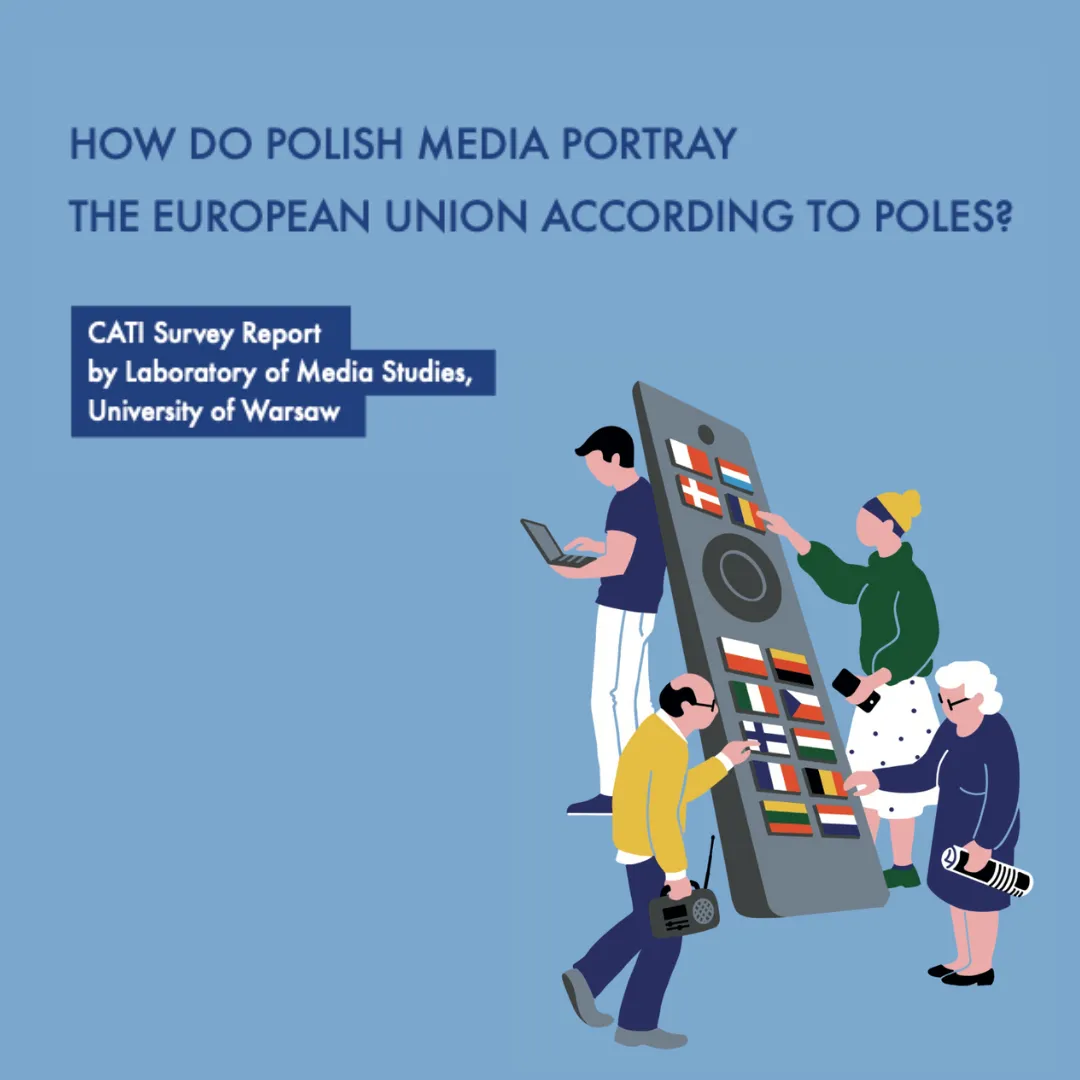
This year marks the 20th anniversary of Poland's accession to the European Union. To commemorate this occasion, the Media Research Laboratory of the University of Warsaw conducted a CATI survey (computer-assisted telephone interviewing) about the EU in Polishmedia, based on the opinions of Poles*. The survey was conducted between June 3-6, 2024, with 1,219 respondents participating.
The Media Research Laboratory team asked Poles what they believe the media they consume daily think about Ukraine's accession to the EU and which countries, according to these same media, are Poland's allies within the European Union. They also inquired about what respondents thought, based on the media, are the main tasks of the EU and which media the surveyed Poles use most often.
We are proud to announce that the latest issue of the Journal of the Association for Information Science and Technology features an article co-authored by LBM member Anna Mierzecka, titled: "Empowering through digital skills: A case of alumni in the business services sector".
The researchers, in an international collaboration: Marek Deja,Isto Huvila, Piotr Bobkowski and Anna Mierzecka,analyzed whether and how digital skills courses influence the career outcomes of humanities and social sciences graduates in the job market.
We are proud to announce that members of our team, Karolina Brylska, Tomasz Gackowski together with Anita Kwiatkowska, and Martyna Dudziak-Kisio, have published a scientific article in the prestigious journal *Information Technology & People*. The publication is titled: "Fun, experience or education? Learning efficiency – virtual reality lesson vs traditional lesson".
The article addresses key issues related to the effectiveness of teaching in virtual reality compared to traditional educational methods. The authors analyze how different teaching approaches, including the use of VR, impact student engagement and learning outcomes.
This study is an important contribution to the development of new educational technologies and highlights how innovative teaching methods can shape the future of education.
We warmly congratulate the authors and invite you to read the full text of the article!
We are proud to announce that the latest edition of Lecture Notes in Networks and Systems features a conference paper (MIDI 2023) co-authored by LBM members - Adam Balcerzak, Marcin Łączyński and prof. Tomasz Gackowski, entitled: "Real-Time Gameplay Data and Biometric Measurement Integration as a Data Source for Game User Research".
We are delighted to announce that the Journal of Librarianship and Information Science has published an article co-authored by Anna Mierzecka, Magdalena Paul, and Małgorzata Kisilowska-Szurmińska.
The publication is titled: “Public libraries’ role in supporting Ukrainian refugees: A focus on Hungary and Poland".
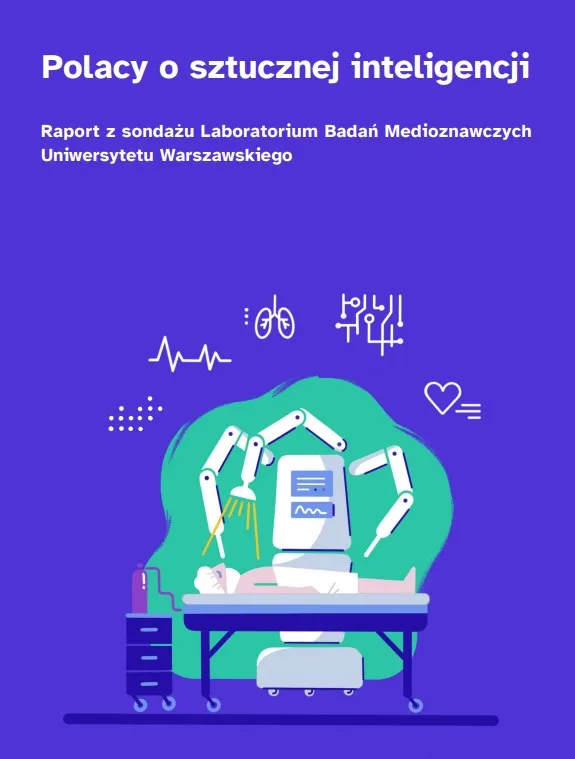
Poles want deliveries using smart drones and care robots, but they are afraid of autonomous cars – these are the conclusions of a survey conducted by the Laboratory of Media Studies at UW dedicated to artificial intelligence. At the same time, Poles do not see the need to regulate this area by law, and a significant part of them has not yet encountered this issue at all. - It is possible that the term "robot" primarily brings to mind the adjective "kitchen" – admits Prof. Tomasz Gackowski, head of the Laboratory of Media Studies.
The head of LBM UW, Prof. Tomasz Gackowski, is a co-author of a recently published article in Nature Human Behaviour, diagnosing the surprising fact that efforts to combat disinformation may unintentionally contribute to increasing citizens' distrust of all media messages, including those that are credible.
We encourage you to read: Emma Hoes, Brian Aitken, Jingwen Zhang, Tomasz Gackowski, and Magdalena Wojcieszak. Prominent Misinformation Interventions Reduce Misperceptions but Increase Skepticism. Nature Human Behaviour. 10 June 2024, DOI: 10.1038/s41562-024-01884-x
We are pleased to announce that following the recent ECIL 2023 conference, a book has been published, featuring a chapter by Karolina Brylska!
The publication is titled: “Who are Physicians Talking to on Social Media? Needed Data Literacy and Visual Literacy of the Assumed Audience(s) of COVID-19 Vaccination Posts”.
The war in Ukraine has caused Poles to share fears about their future – show the results of CATI Survey conducted by Laboratory of Media Studies of the University of Warsaw.
The survey, conducted by the Media Studies Laboratory team, is an interesting illustration of the opinions of Polish women and men on how the Russian-Ukrainian war looks as seen through the windows of their homes and the screens of their smartphones – says dr Karolina Brylska (University of Warsaw, Laboratory of Media Studies deputy director)
After two years of fighting a pandemic, during a period of great uncertainty, it seems that the war in Ukraine might be seen as the straw that broke the camel's back; in the coming months this may cause many breakthroughs and reevaluations, in social, economic, and political life – states prof. Tomasz Gackowski (University of Warsaw, Laboratory of Media Studies deputy director).
In a prestigious scientific journal „Political Behavior” (ISSN 1573-6687; Impact Factor 3,169), an article co-authored by prof. Tomasz Gackowski (head of the LBM UW) entitled The (Null) Effects of Happiness on Affective Polarization, Conspiracy Endorsement, and Deep Fake Recognition: Evidence from Five Survey Experiments in Three Countries has been published.
We invite you to read the new scientific article by dr hab. Tomasz Gackowski and Dr. Karolina Brylska, published in the "Journalism" SAGE Journal Machiavellian Russia’ in the Crimean conflict: Clarification of strategic narratives analysis method DOI: https://doi.org/10.1177%2F1464884920928157
Poles do not believe in the objectivity of Polish news services in the context of reporting on the 100th anniversary of independence, according to a survey conducted by the Laboratory of Media Studies of the University of Warsaw.
The aim of the study was to find out what is the opinion of Poles on Independence Day and the ways of its presentation by the media. In the report, we present the most important findings of the survey.
Poles clearly express no confidence in TV broadcasters. “In this context, I see a certain paradox - in some statements of the respondents there is an echo of the narrative of the main news services, there appear popular media terms and epithets. Therefore, we evaluate TV stations as not fulfilling the criteria of impartiality, and at the same time we soak up the messages that these stations generate - says Karolina Brylska (PhD),University of Warsaw, Deputy Head of the Laboratory of Media Studies).
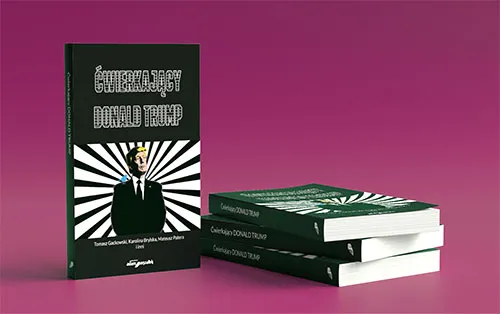
At the end of 2018, another publication by the team of Laboratory of Media Studies UW was released - a multi-author monograph entitled "Tweeting Donald Trump. What is Twitter for users, journalists and the US President? From discourse analysis to eye-tracking research "(T. Gackowski, K. Brylska, M. Patera and others; reviewed by Agnieszka Hess (PhD) from the Jagiellonian University and professor Radosław Pawelec from the University of Warsaw). The authors present a multifaceted review of an interesting media and political phenomenon, which is the use of social media (on the example of Twitter) as a tool for shaping modern "soft power". This concept is based on the ability to shape other people's preferences without the use of pressure or violence, but rather with the help of a country's cultural resources. In this process, various diplomatic practices and communication tools useful at the international level are used, including Twitter, whose growing importance in conducting public diplomacy is reflected in the increasingly popular term "Twiplomacy".
Głowacka E., Kisilowska M., Paul M., Information Literacy of Polish Students in Social Sciences and Humanities. “Zagadnienia Informacji Naukowej” 2018 vol. 56 nr 1 s. 33-51.
Anna Jupowicz-Ginalska (2018). Exposure of Travel Destinations on the Front Covers of the Magazines National Geographic Traveler and Podróże, “Journal of Tourism and Services”, Volume IX, Issue 17, s. 27-54.
Anna Jupowicz-Ginalska (2018), Wybrane elementy budowy frontowych okładek magazynów a reakcje polskich odbiorców, „Naukowy Przegląd Dziennikarski”, tom: 1, zeszyt: 25, s. 7-33.
Anna Jupowicz-Ginalska (2018), Młodzież a cyfrowe kompetencje operacyjne - na podstawie modelu dostępu do nowych mediów Jana van Dijka, „Kultura-Media-Teologia”, tom: 32, zeszyt: 1, strony: 8-24 (tekst opracowany w zespole, w skład którego weszły: Anna Jupowicz-Ginalska, Justyna Jasiewicz, Małgorzata Kisilowska, Alicja Waszkiewicz-Raviv).
Fear of Missing Out a korzystanie z urządzeń umożliwiających dostęp do mediów społecznościowych – w oparciu o badania polskich internautów, "Forum Socjologiczne", tekst opracowany w zespole, w skład którego weszli: Anna Jupowicz-Ginalska, Justyna Jasiewicz, Małgorzata Kisilowska, Tomasz Baran, Aleksander Wysocki
Biometric Tools in Information Science. The Example of an Information Literacy Study – A Holiday Planning Experiment, "Information literacy in everyday life", Tekst opracowany w zespole, w skład którego weszły: Anna Jupowicz-Ginalska, Justyna Jasiewicz, Małgorzata Kisilowska
Walencja emocjonalna on-line. Kompetencje cyfrowe a pomiar reakcji emocjonalnych w świetle badań jakościowych, tekst opracowany w zespole, w skład którego weszły: Anna Jupowicz-Ginalska, Justyna Jasiewicz, Alicja Waszkiewicz-Raviv.
Głowacka E., Górny M., Kisilowska M., Osiński Z., Wpływ cyfryzacji infrastruktury informacyjnej na procesy badawcze w humanistyce. Wybrane aspekty zjawiska. „Zagadnienia Informacji Naukowej” 2017 nr 2 s. 137-155.
Kisilowska M., Mierzecka A., Emotions, experience, identity -motivations of the teens' information behaviour in the area of culture. “Information Research Journal”
Kisilowska M., Brylska K., Szurmiński Ł., The use of biometric research in political and media sciences - literature review and new fields of research. “Australian Journal of Political Science”.
Mierzecka-Szczepańska, A. (2012). Ewaluacja efektywności systemów informacyjno-wyszukiwawczych - wybrane parametry ocen [Information retrieval system evaluation – selected metrics]. W B. SosińskaKalata & E. Chuchro (red.), Społeczeństwo i sieć informacyjna. Problemy i technologie (s. 111-124). Warszawa: Wydawnictwo SBP.
Szczepańska, A. (2006). Strategia, heurystyka i taktyka wyszukiwania informacji. Próba uporządkowania pojęć [Strategy, Heurystics and Tactics Of Information Retrieval. An Attempt of Concept Arrangement]. Przegląd Biblioteczny, 74(2), 165- 187.
Szczepańska, A. (2007). Podstawowe strategie wyszukiwania informacji i ich wykorzystanie w praktyce [The Basic Information Retrieval Strategies and Their Use in Practice]. Przegląd Biblioteczny, 75(2), 233-251.
Kuźmina, D., & Szczepańska, A. (2011). Bibliologiczne wsparcie w sieci [Library science online suport]. W D. Kuźmina (Ed.), Bibliologia i informatologia (s. 251-266). Warszawa: PTB OW.
Mierzecka-Szczepańska, A. (2013). Badania użytkowników dokumentacyjnych systemów wyszukiwawczych [Information retrieval systems users]. W B. Sosińska-Kalata & E. Chuchro (red.), Nauka o informacji w okresie zmian (s. 333-346). Warszawa: Wydawnictwo SBP.
Mierzecka, A., & Suminas, A. (2018). Academic library website functions in the context of users’ information needs. Journal of Librarianship and Information Science, 50(2), 157-167. doi:10.1177/0961000616664401
Jasiewicz J., Mierzecka A., & Kisilowska, M. (2018). Complex and Multivariable: Methodology of Exploring Digital Literacy and Training Needs Within the Polish SME Sector. Communications in Computer and Information Science, 810, 322-331. doi:https://doi.org/10.1007/978-3-319-74334-9_34
Grigas, V., Mierzecka, A., & Fedosejevaitė, R. (2018). School Librarians’ Attitudes Towards Teaching Information Literacy. Communications in Computer and Information Science 810, 703-712. doi:https://doi.org/10.1007/978-3-319-74334-9_72
Mierzecka, A., Kisilowska, M., & Suminas, A. (2017). Researchers’ Expectations Regarding the Online Presence of Academic Libraries. College & Research Libraries, 78(7), 934-951. doi:10.5860/crl.78.7.934
Mierzecka, A., Kisilowska, M., & Jasiewicz, J. (2018). Dostęp to za mało… Usługi cyfrowe w instytucjach kultury: oferta Narodowego Instytutu Audiowizualnego a oczekiwania i kompetencje młodych użytkowników [Acess Is Not Enough… Digital Services Of Cultural Institutions: The National Audiovisual Institute Resources Vs. Expectations And Competencies Of Teen Users]. W B. Sosińska-Kalata, P. Tafiłowski, & Z. Wiorogórska (red.), Nauka o informacji w okresie zmian: innowacyjne usługi informacyjne (s. 289-305). Warszawa: Wydawnictwo SBP.
Mierzecka, A. (2017). Ewaluacja rozwiązań wyszukiwania treści stosowanych przez europejskie biblioteki akademickie w kontekście nawyków informacyjnych użytkowników [Search possibilities at the websites of European academic libraries in the context of users’ information behaviour]. W R. Sapa (red.), Diagnostyka w zarządzaniu informacją: perspektywa informatologiczna (s. 347-363). Kraków: Biblioteka Jagiellońska.
Mierzecka, A. (2017). Działalność lokalnych instytucji kultury na rzecz rozwoju kompetencji cyfrowych [Local cultural institutions' activities for the development of digital competencies]. W A. Mierzecka & E. B. Zybert (Eds.), Instytucje kultury jako ośrodki życia społecznego (s. 91-105). Warszawa: Wydawnictwo SBP.
Mierzecka, A., Kisilowska, M., & Jasiewicz, J. (2016). Świetlice szkolne jako potencjalna przestrzeń edukacji cyfrowej [Elementary Schools’ Common Rooms as Potential Space for Digital Literacy]. W A. Kwiatkowska & M. Sysło (red.), Informatyka w edukacji: kształcenie informatyczne i programowanie dla wszystkich uczniów (s. 265–277). Toruń: Wydawnictwo Naukowe Uniwersytetu Mikołaja Kopernika.
Kisilowska, M., Jasiewicz, J., & Mierzecka, A. (2016). Relationality Is the Key: The Family of Digital Competencies’ Catalogues and Their Potential Applications. Communications in Computer and Information Science, 676, 294-303. doi.org/10.1007/978-3-319-52162-6_29
Grigas, V., Fedosejevaitė, R., & Mierzecka, A. (2016). Librarians as Educators: Affective Dimensions Experienced in Teaching. Communications in Computer and Information Science, 676, 619-633. doi:10.1007/978-3-319-52162-6_61
Mierzecka, A. (2015). Information Behaviors within the Humanities: Searching or Browsing, Recall or Precision? Zagadnienia Informacji Naukowej – Studia Informacyjne / Issues in Information Science. Information Studies, 53(1), 82-95.
Suminas, A., & Mierzecka, A. (2014). Political Information Sources For Young Citizens: A Case Study Of Lithuanian Youth Information Behavior. Informacijos mokslai / Information Science, 70, 25-44.
Mierzecka, A., & Suminas, A. (2016). Cyfrowa przestrzeń jako narzędzie organizacji, udostępniania i promocji oferty bibliotek akademickich [Digital Space as a Tool to Organize, Share and Promote Academic Libraries]. Kultura Popularna, 4(50), 50-73. doi:10.5604/01.3001.0010.0043
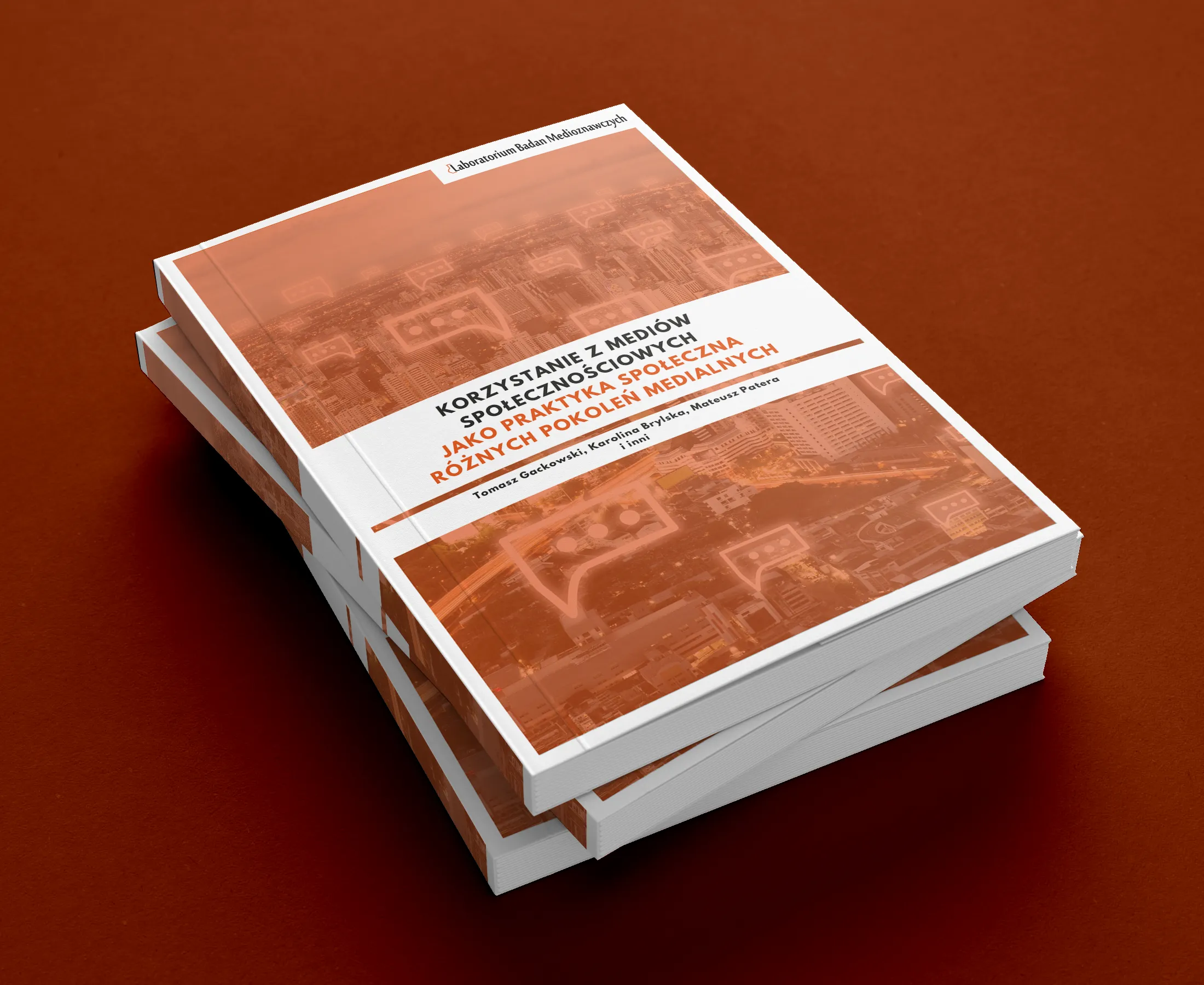
We would like to inform you that a new publication of the Laboratory of Media Studies - a multi-faction monograph entitled "Using social media as a social practice of different generations of media".
The survey, the result of which is the publication, was to help answer the question of what Poles think about the visit of US President Donald Trump in Poland and how they evaluate the presentation of the American leader in the Polish media.
Gackowski T., Brylska, K., Patera M. et al. (Zespół LBM UW), Badanie okulograficzne aplikacji BiznesRadar [BiznesRadar application - Eyetracking research), Laboratorium Badań Medioznawczych UW/Laboratory of Media Studies University of Warsaw, kwiecień 2017 r.
Gackowski T., Brylska, K., Patera M. et al. (Zespół LBM UW), Polacy o konflikcie na Ukrainie - sondaż LBM UW, [Poles about conflict in Ukraine - LBM polling], Laboratorium Badań Medioznawczych UW/Laboratory of Media Studies University of Warsaw, luty 2017 r.
Gackowski T., Brylska, K., Patera M. et al. (Zespół LBM UW), Polski dyskurs prasowy o konflikcie na Ukrainie. Perspektywa porównawcza 2014-2015 [Conflict in Ukraine in Polish Press Discourse. Comparistic study 2014-2015] , Laboratorium Badań Medioznawczych UW/Laboratory of Media Studies University of Warsaw, luty 2017 r.
Gackowski T., Łączyński M., Majchrzyk Ł., Matyja A., Wieczorkowski M., Skrypt do analizy zawartości prasy [Script for content analysis of the press], Warsaw 2007 (130 pp.).
Gackowski T., Łączyński M., Analiza wizerunku w mediach. Podręcznik [Analysis of the image in mass media. Guidebook] (research cooperation: A. Balcerzak, Ł. Majchrzyk, A. Matyja, M. Wieczorkowski), Warsaw 2008 (324 pp.).
Gackowski T., Łączyński M., Metody badania wizerunku w mediach. Czym jest wizerunek. Jak i po co należy go badać [Methods for testing image in mass media. What is the image? How and what should be examined?] (research cooperation: A. Balcerzak, Ł. Majchrzyk, A. Matyja, M. Wieczorkowski), Warsaw 2009 (300 pp.).
Gackowski T. (ed.), Quo vaditis? Interdyscyplinarne horyzonty nauk o mediach [Quo vaditis? Interdisciplinary horizons of media studies], Warsaw 2012 (309 pp.).
Gackowski T., Dziedzic J. (eds.), Manipulacja w mediach. Media o manipulacji [The manipulation in the media. Media about the manipulation], Warsaw 2011 (284 pp.).
Gackowski T. (ed.), Zawartość mediów, czyli rozważania nad metodologią badań medioznawczych [Content of media which means delibarations about methodology in media studies], Warsaw 2011 (154 pp.).
Gackowski T., Gackowska A., Dziedzic J. (eds.), PR w RP, czyli dwadzieścia polskiej branży public relations [Public relations in Republic of Poland, the polish twenty public relations industry], Warsaw 2010 (168 pp.).
Gackowski T. (ed.), I Ogólnopolski Zjazd Analityków Mediów pt. «Mediokracja a demokracja» [Ist Media Analysts National Congress with the title Mediocracy or Democracy], Warsaw 2009 (181 pp.).
Gackowski T., Twitter w rękach polityków. Rzecz o metodologii i potencjale badań mediów społecznościowych [Twitter in hands of politicians. The issue of methodology and potential of social media research], [w:] Metodologie badań medioznawczych [Methodology of media studies], red. T. Gackowski, seria „Media początku XXI wieku”, t. 26, Oficyna Wydawnicza Aspra-JR, Warszawa 2014, s. 163–208.
Gackowski T., W świetle teczek Służby Bezpieczeństwa [In light of the portfolios of the Security Service], [in:] M. Jabłonowski, R. Habielski (eds.), Stefan Kisielewski 1911–1991–2011, Warsaw 2011, pp. 261–299.
Gackowski T., Zamiast przedmowy. Manipulacja immanentną cechą mediów? [Instead of the foreword. Manipulation in media as a inherent feature?], [in:] T. Gackowski, J. Dziedzic (eds.), Manipulacja w mediach. Media o manipulacji [The manipulation in the media. Media about the manipulation], Warsaw 2011, pp. 7–17.
Gackowski T., Kilka słów o projekcie list frekwencyjnych w dziennikach ogólnopolskich w 2008 roku [A few words about the project of creating lists of frequency in national dailies in 2008], [in:] T. Gackowski (ed.), I Ogólnopolski Zjazd Analityków Mediów pt. «Mediokracja a demokracja» [Ist Media Analysts National Congress with the title «Mediocracy and Democracy»], Warsaw 2009, pp. 13–43.
Gackowski T., Podsumowanie: system PR-owski w Polsce? [Summary: PR-ish system in Poland?], [in:] T. Gackowski, A. Gackowska, J. Dziedzic (eds.), PR w RP, czyli dwadzieścia polskiej branży public relations [Public relations in Republic of Poland, the polish twenty public relations industry], Warsaw 2010, pp. 78–93.
Gackowski T., Łączyński M., Brylska K. oraz Departament Monitoringu KRRiT, Monitoring wyborczy telewizyjnych serwisów informacyjnych. Wybory parlamentarne 2015. Raport podsumowujący, sierpień 2015 r. [Gackowski T., Łączyński M., Brylska K. and Departament of Monitoring Polish National Broadcasting Council, Analysis of TV news in public and commercial television stations. Parliamentary Elections. Summary Report, August 2015].
Gackowski T., Raport otwarcia (brief – ekspertyza) dla Europejskiego Forum Nowych Idei 2012 – PKPP Lewiatan pt. Lider czy statysta? Europa w wielobiegunowym świecie / Perspektywa biznesu (Sopot, 26–28 września 2012 r.), panel poświęcony mediom opiniotwórczym w Unii Europejskiej, ze szczególnym uwzględnieniem mediów publicznych – dla uczestników panelu dyskusyjnego pt. Czy UE przeżyje bez europejskich mediów publicznych? Moderator: Andrzej Goldewski (TVP). Uczestnicy: Juliusz Braun (TVP), Ingrid Delterne (EBU), Grzegorz Hajdarowicz (Gremi Group) oraz Aleksander Scheuer (EML) [Opening Report (brief – expertise) for the European Forum for New Ideas 2012 – Lewiatan entitled Leader or stat? Europe in a multipolar world / Business perspective (Sopot, 26–28 September 2012); A Panel about Media Opinion Leaders in The European Union, with Particular Emphasis on Public Media – for The Participants of The Panel Discussion entitled Will The EU Survive Without European Public Media? Moderator: Andrew Goldewski (TVP), Participants: Juliusz Braun (TVP), Ingrid Delterne (EBU), Gregory Hajdarowicz (Gremi Group), and Alexander Scheuer (EML).
Gackowski T., “My Little Pony” in adults' eyes eyes. How do men and women watch cartoons? An eye-tracking experiment, Proceedings IEEE - 2016 9th International Conference on Human System Interactions (HSI) (5-6 July 2016, Portsmouth, UK), IEEE, DOI: 10.1109/HSI.2016.7529672 s. 444 - 450. (JCR List, IF)
Gackowski T.,Przyszłość prasy na podstawie polskiego rynku – wyzwania i szanse, [Future of the press - challanges and opportunities - Polish press maket example], [w:] Nauki o mediach i komunikacji społecznej. Krystalizacja dyscypliny w Polsce. Tradycje, nurty, problemy, rezultaty, [Media and Communication studies. Crystallization of discipline in Poland. Traditions, trends, problems, results], red. A. Adamski, S. Gawrońskiego, M. Szewczyk, Rzeszów 2017, s. 119-133.
We are pleased to announce the publication of a book dedicated to the creation and operation of media research laboratories - Creating Communication and Media Research Labs: A Blueprint for Success. This is the first publication to focus not on research outcomes, but on the processes and practices behind establishing such labs.
The volume, published by Palgrave Macmillan, includes our chapter: “The Laboratory of Media Studies (LMS): The Lab of Social Narratives, Opinions, Behaviors, and Experiences”, authored by dr Karolina Brylska and prof. Tomasz Gackowski.
We’re excited to share some great news - a new book has just been published – “Knowledge – Communication – Action. Media Practices in a Digitalized World”, edited by prof. Agnieszka Hess, prof. Maria Nowina-Konopka and prof. Weronika Świerczyńska-Głownia.
The volume also features a chapter authored by members of our team - Tomasza Gackowskiego, Anny Mierzeckiej, Marleny Sztyber-Popko and Marcina Łączyńskiego: : “Between the Fear of Intelligent Machines and Trust in New Technologies: Perceptions of Artificial Intelligence in Public Opinion Research”.
We are delighted to share that Marcin Łączyński has become a co-author of the book “Adaptation of Residential Estates to Climate Change”, published by SGGW.
This is an important, innovative, and practical guide for everyone who wants to actively counteract the effects of climate change in their surroundings – from residents and young people to community leaders.
At the end of 2018, another publication by the team of Laboratory of Media Studies UW was released - a multi-author monograph entitled "Tweeting Donald Trump. What is Twitter for users, journalists and the US President? From discourse analysis to eye-tracking research "(T. Gackowski, K. Brylska, M. Patera and others; reviewed by Agnieszka Hess (PhD) from the Jagiellonian University and professor Radosław Pawelec from the University of Warsaw). The authors present a multifaceted review of an interesting media and political phenomenon, which is the use of social media (on the example of Twitter) as a tool for shaping modern "soft power". This concept is based on the ability to shape other people's preferences without the use of pressure or violence, but rather with the help of a country's cultural resources. In this process, various diplomatic practices and communication tools useful at the international level are used, including Twitter, whose growing importance in conducting public diplomacy is reflected in the increasingly popular term "Twiplomacy".
We would like to inform you that a new publication of the Laboratory of Media Studies - a multi-faction monograph entitled "Using social media as a social practice of different generations of media".
Gackowski T., Łączyński M., Majchrzyk Ł., Matyja A., Wieczorkowski M., Skrypt do analizy zawartości prasy [Script for content analysis of the press], Warsaw 2007 (130 pp.).
Gackowski T., Łączyński M., Analiza wizerunku w mediach. Podręcznik [Analysis of the image in mass media. Guidebook] (research cooperation: A. Balcerzak, Ł. Majchrzyk, A. Matyja, M. Wieczorkowski), Warsaw 2008 (324 pp.).
Gackowski T., Łączyński M., Metody badania wizerunku w mediach. Czym jest wizerunek. Jak i po co należy go badać [Methods for testing image in mass media. What is the image? How and what should be examined?] (research cooperation: A. Balcerzak, Ł. Majchrzyk, A. Matyja, M. Wieczorkowski), Warsaw 2009 (300 pp.).
Gackowski T. (ed.), Quo vaditis? Interdyscyplinarne horyzonty nauk o mediach [Quo vaditis? Interdisciplinary horizons of media studies], Warsaw 2012 (309 pp.).
Gackowski T., Dziedzic J. (eds.), Manipulacja w mediach. Media o manipulacji [The manipulation in the media. Media about the manipulation], Warsaw 2011 (284 pp.).
Gackowski T. (ed.), Zawartość mediów, czyli rozważania nad metodologią badań medioznawczych [Content of media which means delibarations about methodology in media studies], Warsaw 2011 (154 pp.).
Gackowski T., Gackowska A., Dziedzic J. (eds.), PR w RP, czyli dwadzieścia polskiej branży public relations [Public relations in Republic of Poland, the polish twenty public relations industry], Warsaw 2010 (168 pp.).
Gackowski T. (ed.), I Ogólnopolski Zjazd Analityków Mediów pt. «Mediokracja a demokracja» [Ist Media Analysts National Congress with the title Mediocracy or Democracy], Warsaw 2009 (181 pp.).
The paper analyses the rhetorical strategies employed by Ukrainian President Volodymyr Zelenskyy in 22 speeches delivered in March 2022, at the onset of the Russian invasion.
Zelenskyy presents Russia as the aggressor and Ukraine as a defender of democratic values. Using textual coding in QDA Miner, the study examines the balance between the “politics of hope” and the “politics of fear”.
The analysis also highlights a dichotomy between the global democratic community and Russia. The speeches combine traditional and modern elements of war propaganda to mobilise international solidarity and support for Ukraine.
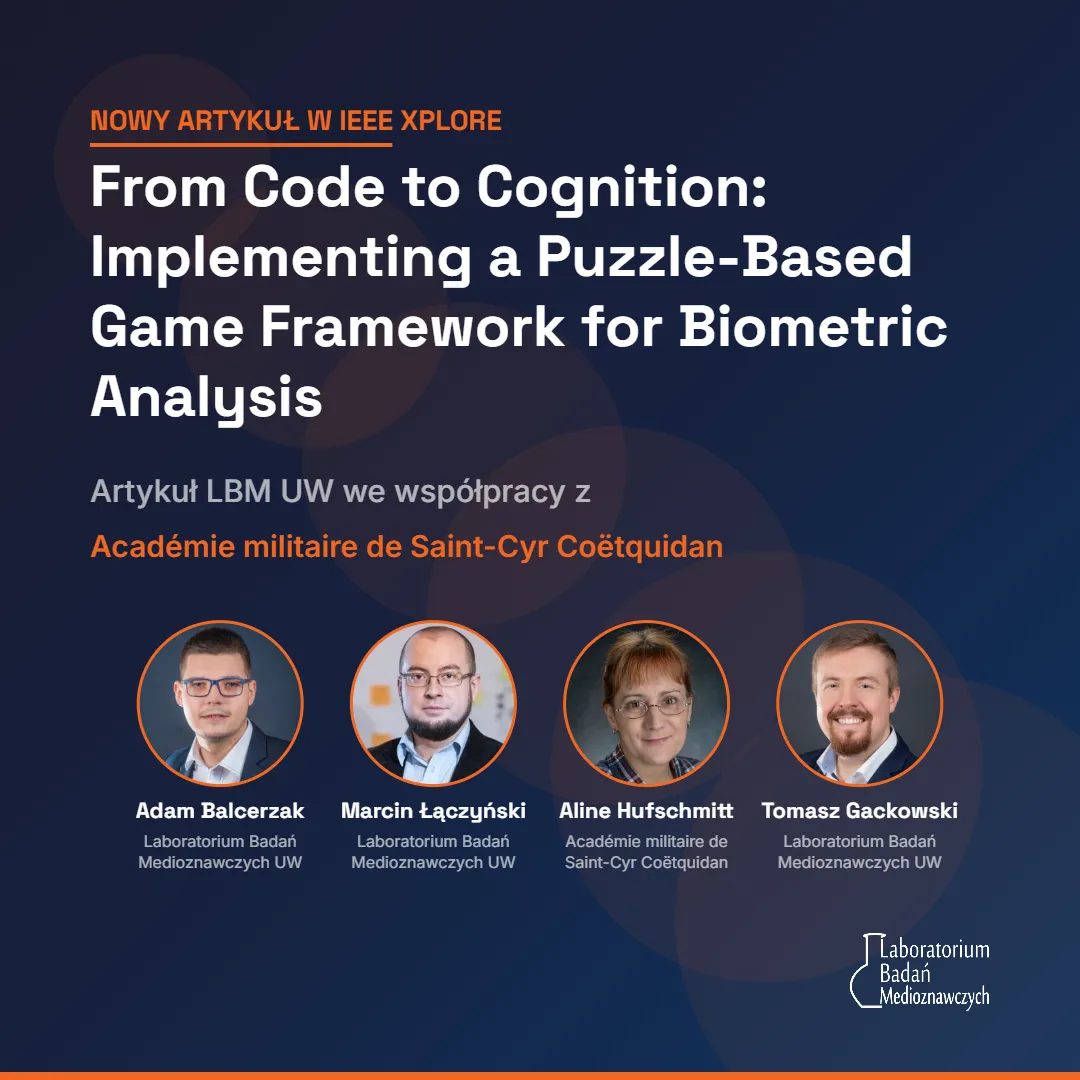
We are pleased to announce the publication of three research papers authored by researchers from the Laboratory of Media Studies, University of Warsaw.
The publications cover three distinct research areas developed within the Laboratory. The first paper presents the design and implementation of a highly available research infrastructure based on Proxmox VE, focusing on solutions that ensure reliability, scalability, and continuity of research services. The second paper examines the feasibility of conducting remote biometric studies on advertisement perception using webcams and emotion recognition technologies as an alternative to traditional laboratory-based experiments. The third publication explores the use of virtual reality and multimodal biometric measurements to investigate the workload and emotional responses of FPV drone operators.
How does simple language build accessibility, safety, and trust? In July 2026, "Poradnik Językowy" (Volume 834, No. 5 2026) published a report by a team of researchers led by Dr. Jacek Wasilewski.
The team examined how simple and understandable language affects the perception of texts by neuroatypical and neurotypical individuals.
Why do even well-informed parents sometimes have doubts about vaccinating their children?
Whom do they trust, and how do they make health-related decisions in the age of disinformation?
We recommend a new article published on the University of Warsaw Science News Service, based on research conducted by members of the LBM at the University of Warsaw - Anna Mierzecka and Marcin Łączyński.
The article shows that decisions concerning vaccination are far more complex than a simple division between “supporters” and “opponents” of science. Emotions, personal experiences, and the ways in which people consume information in digital media all play a major role.
The publication follows a presentation delivered at ACDSA 2026 – International Conference on Artificial Intelligence, Computer, Data Sciences and Applications, held on February 5–7, 2026, in Boracay, Philippines under IEEE patronage.
We are proud to announce that Journal of Media Business Studies has published an article co-authored by dr Karolina Brylska!
The publication is titled: Fear factor: a scoping study of the role of fear in news media management during crises.
Congratulations, and we warmly encourage you to read the full article.
Nel, F. P., Bernhard, M., Brylska, K., Waschková Císařová, L., & Sidyk-Furman, D. (2025). Fear factor: a scoping study of the role of fear in news media management during crises. Journal of Media Business Studies, 1–32. https://doi.org/10.1080/16522354.2025.2593761
We are proud to announce that a conference paper by Adam Balcerzak and Julia Kwiatkowska has been published by Springer!
The publication is titled: “Balancing Beauty and Usability: A Comprehensive Evaluation of Awwwards-Winning Websites” and appears in the volume Digital Interaction and Machine Intelligence (MIDI 2024), part of the series Lecture Notes in Networks and Systems, vol. 1636, edited by C. Biele et al.
We are proud to announce that Journal of the Association for Information Science and Technology has published an article authored by prof. Anna Mierzecka and Marcin Łączyński!
The publication is titled: "Parents information behavior: Typology of vaccine attitudes in the context of information source use”.
We encourage you to read the publication co-authored by Marcin Łączyński – "Can the serious game serve as a tool for education in founding local adaptation solutions to climate change?"!
Kuchcik, M., Łączyński, M., Cieszewska, A., Adamczyk-Jabłońska, J., Giedych, R., Maksymiuk, G., & Pusławska-Tyszewska, D. (2024). Can the serious game serve as a tool for education in founding local adaptation solutions to climate change? Geographia Polonica, 97(4), 485-498. https://doi.org/10.7163/GPol.0289
We encourage you to read the publication co-authored by prof. Tomasz Gackowski – "Effects of Over-Time Exposure to Partisan Media and Coverage of Polarization on Perceived Polarization"!
Heseltine, M., Clemm von Hohenberg, B., Menchen-Trevino, E., Gackowski, T., & Wojcieszak, M. (2024). Effects of Over-Time Exposure to Partisan Media and Coverage of Polarization on Perceived Polarization. Political Communication, 1–22. https://doi.org/10.1080/10584609.2024.2423093
We encourage you to read prof. Anna Mierzecka’s publication — "Academics’ information needs from the librarians’ perspective: A study of the research community of practice"!
Mierzecka, A. (2025). Academics’ information needs from the librarians’ perspective: A study of the research community of practice. The Journal of Academic Librarianship, 51(1), 103004. https://doi.org/10.1016/j.acalib.2024.103004
We invite you to read dr Karolina Brylska’s publication — "Who are Physicians Talking to on Social Media? Needed Data Literacy and Visual Literacy of the Assumed Audience(s) of COVID-19 Vaccination Posts"!
Brylska, K. (2024). Who are Physicians Talking to on Social Media? Needed Data Literacy and Visual Literacy of the Assumed Audience(s) of COVID-19 Vaccination Posts. In: Kurbanoğlu, S., et al. Information Experience and Information Literacy. ECIL 2023. Communications in Computer and Information Science, vol 2042. Springer, Cham. https://doi.org/10.1007/978-3-031-53001-2_8
We are proud to announce that The Journal of Academic Librarianship has published an article authored by Prof. Małgorzata Kisilowska-Szurmińska, a long-time collaborator with LBM! The publication is titled: "Artificial intelligence in academic libraries – a tool, a collaborator, an adversary? A Delphi study of university librarians in Poland".
Congratulations, and we warmly encourage you to read the full article:
We are proud to announce that Res Rhetorica has published an article authored by dr Karolina Brylska!
The publication is titled: “Fight for historical truth or political gameplay? Strategic narratives in Polish TV news coverage of the 2018 Polish–Israeli diplomatic crisis”.
Congratulations, and we encourage you to read the full article:
We are pleased to announce that a new article co-authored by Professor Anna Mierzecka and Professor Małgorzata Kisilowska-Szurmińska has been published in the prestigious journal Information Research – an international electronic journal, under the title Public library services for migrants in national government policies across eight European countries: a comparative analysis.
We are delighted to announce that Games and Culture has published a new article by Tomasz Gackowski, Marcin Łączyński and Michał Gołębiowski.
The publication is titled: "Variety or Similarity: The Typology and Frequency of Occurrence of Certain Kinds of Puzzles Present in Puzzle-Based Gamebooks”.
We are delighted to inform you that Professor Jacek Wasilewski has published a new co-authored chapter in the prestigious publication Trust, Media and the Economy.
The title of the chapter is: Trust, sense of control, and diffusion of narratives.
We encourage you to read it, as it thoroughly discusses how the changing economic situation shapes contemporary narratives about trust and control.
We are thrilled to announce that an article co-authored by Marcin Łączyński has been published in "Geographia Polonica"! The article is titled: "Can the serious game serve as a tool for education in founding local adaptation solutions to climate change?”
We are proud to announce that the latest issue of the Journal of the Association for Information Science and Technology features an article co-authored by LBM member Anna Mierzecka, titled: "Empowering through digital skills: A case of alumni in the business services sector".
The researchers, in an international collaboration: Marek Deja,Isto Huvila, Piotr Bobkowski and Anna Mierzecka,analyzed whether and how digital skills courses influence the career outcomes of humanities and social sciences graduates in the job market.
We are proud to announce that members of our team, Karolina Brylska, Tomasz Gackowski together with Anita Kwiatkowska, and Martyna Dudziak-Kisio, have published a scientific article in the prestigious journal *Information Technology & People*. The publication is titled: "Fun, experience or education? Learning efficiency – virtual reality lesson vs traditional lesson".
The article addresses key issues related to the effectiveness of teaching in virtual reality compared to traditional educational methods. The authors analyze how different teaching approaches, including the use of VR, impact student engagement and learning outcomes.
This study is an important contribution to the development of new educational technologies and highlights how innovative teaching methods can shape the future of education.
We warmly congratulate the authors and invite you to read the full text of the article!
We are proud to announce that the latest edition of Lecture Notes in Networks and Systems features a conference paper (MIDI 2023) co-authored by LBM members - Adam Balcerzak, Marcin Łączyński and prof. Tomasz Gackowski, entitled: "Real-Time Gameplay Data and Biometric Measurement Integration as a Data Source for Game User Research".
We are delighted to announce that the Journal of Librarianship and Information Science has published an article co-authored by Anna Mierzecka, Magdalena Paul, and Małgorzata Kisilowska-Szurmińska.
The publication is titled: “Public libraries’ role in supporting Ukrainian refugees: A focus on Hungary and Poland".
The head of LBM UW, Prof. Tomasz Gackowski, is a co-author of a recently published article in Nature Human Behaviour, diagnosing the surprising fact that efforts to combat disinformation may unintentionally contribute to increasing citizens' distrust of all media messages, including those that are credible.
We encourage you to read: Emma Hoes, Brian Aitken, Jingwen Zhang, Tomasz Gackowski, and Magdalena Wojcieszak. Prominent Misinformation Interventions Reduce Misperceptions but Increase Skepticism. Nature Human Behaviour. 10 June 2024, DOI: 10.1038/s41562-024-01884-x
We are pleased to announce that following the recent ECIL 2023 conference, a book has been published, featuring a chapter by Karolina Brylska!
The publication is titled: “Who are Physicians Talking to on Social Media? Needed Data Literacy and Visual Literacy of the Assumed Audience(s) of COVID-19 Vaccination Posts”.
In a prestigious scientific journal „Political Behavior” (ISSN 1573-6687; Impact Factor 3,169), an article co-authored by prof. Tomasz Gackowski (head of the LBM UW) entitled The (Null) Effects of Happiness on Affective Polarization, Conspiracy Endorsement, and Deep Fake Recognition: Evidence from Five Survey Experiments in Three Countries has been published.
We invite you to read the new scientific article by dr hab. Tomasz Gackowski and Dr. Karolina Brylska, published in the "Journalism" SAGE Journal Machiavellian Russia’ in the Crimean conflict: Clarification of strategic narratives analysis method DOI: https://doi.org/10.1177%2F1464884920928157
Głowacka E., Kisilowska M., Paul M., Information Literacy of Polish Students in Social Sciences and Humanities. “Zagadnienia Informacji Naukowej” 2018 vol. 56 nr 1 s. 33-51.
Anna Jupowicz-Ginalska (2018). Exposure of Travel Destinations on the Front Covers of the Magazines National Geographic Traveler and Podróże, “Journal of Tourism and Services”, Volume IX, Issue 17, s. 27-54.
Anna Jupowicz-Ginalska (2018), Wybrane elementy budowy frontowych okładek magazynów a reakcje polskich odbiorców, „Naukowy Przegląd Dziennikarski”, tom: 1, zeszyt: 25, s. 7-33.
Anna Jupowicz-Ginalska (2018), Młodzież a cyfrowe kompetencje operacyjne - na podstawie modelu dostępu do nowych mediów Jana van Dijka, „Kultura-Media-Teologia”, tom: 32, zeszyt: 1, strony: 8-24 (tekst opracowany w zespole, w skład którego weszły: Anna Jupowicz-Ginalska, Justyna Jasiewicz, Małgorzata Kisilowska, Alicja Waszkiewicz-Raviv).
Fear of Missing Out a korzystanie z urządzeń umożliwiających dostęp do mediów społecznościowych – w oparciu o badania polskich internautów, "Forum Socjologiczne", tekst opracowany w zespole, w skład którego weszli: Anna Jupowicz-Ginalska, Justyna Jasiewicz, Małgorzata Kisilowska, Tomasz Baran, Aleksander Wysocki
Biometric Tools in Information Science. The Example of an Information Literacy Study – A Holiday Planning Experiment, "Information literacy in everyday life", Tekst opracowany w zespole, w skład którego weszły: Anna Jupowicz-Ginalska, Justyna Jasiewicz, Małgorzata Kisilowska
Walencja emocjonalna on-line. Kompetencje cyfrowe a pomiar reakcji emocjonalnych w świetle badań jakościowych, tekst opracowany w zespole, w skład którego weszły: Anna Jupowicz-Ginalska, Justyna Jasiewicz, Alicja Waszkiewicz-Raviv.
Głowacka E., Górny M., Kisilowska M., Osiński Z., Wpływ cyfryzacji infrastruktury informacyjnej na procesy badawcze w humanistyce. Wybrane aspekty zjawiska. „Zagadnienia Informacji Naukowej” 2017 nr 2 s. 137-155.
Kisilowska M., Mierzecka A., Emotions, experience, identity -motivations of the teens' information behaviour in the area of culture. “Information Research Journal”
Kisilowska M., Brylska K., Szurmiński Ł., The use of biometric research in political and media sciences - literature review and new fields of research. “Australian Journal of Political Science”.
Mierzecka-Szczepańska, A. (2012). Ewaluacja efektywności systemów informacyjno-wyszukiwawczych - wybrane parametry ocen [Information retrieval system evaluation – selected metrics]. W B. SosińskaKalata & E. Chuchro (red.), Społeczeństwo i sieć informacyjna. Problemy i technologie (s. 111-124). Warszawa: Wydawnictwo SBP.
Szczepańska, A. (2006). Strategia, heurystyka i taktyka wyszukiwania informacji. Próba uporządkowania pojęć [Strategy, Heurystics and Tactics Of Information Retrieval. An Attempt of Concept Arrangement]. Przegląd Biblioteczny, 74(2), 165- 187.
Szczepańska, A. (2007). Podstawowe strategie wyszukiwania informacji i ich wykorzystanie w praktyce [The Basic Information Retrieval Strategies and Their Use in Practice]. Przegląd Biblioteczny, 75(2), 233-251.
Kuźmina, D., & Szczepańska, A. (2011). Bibliologiczne wsparcie w sieci [Library science online suport]. W D. Kuźmina (Ed.), Bibliologia i informatologia (s. 251-266). Warszawa: PTB OW.
Mierzecka-Szczepańska, A. (2013). Badania użytkowników dokumentacyjnych systemów wyszukiwawczych [Information retrieval systems users]. W B. Sosińska-Kalata & E. Chuchro (red.), Nauka o informacji w okresie zmian (s. 333-346). Warszawa: Wydawnictwo SBP.
Mierzecka, A., & Suminas, A. (2018). Academic library website functions in the context of users’ information needs. Journal of Librarianship and Information Science, 50(2), 157-167. doi:10.1177/0961000616664401
Jasiewicz J., Mierzecka A., & Kisilowska, M. (2018). Complex and Multivariable: Methodology of Exploring Digital Literacy and Training Needs Within the Polish SME Sector. Communications in Computer and Information Science, 810, 322-331. doi:https://doi.org/10.1007/978-3-319-74334-9_34
Grigas, V., Mierzecka, A., & Fedosejevaitė, R. (2018). School Librarians’ Attitudes Towards Teaching Information Literacy. Communications in Computer and Information Science 810, 703-712. doi:https://doi.org/10.1007/978-3-319-74334-9_72
Mierzecka, A., Kisilowska, M., & Suminas, A. (2017). Researchers’ Expectations Regarding the Online Presence of Academic Libraries. College & Research Libraries, 78(7), 934-951. doi:10.5860/crl.78.7.934
Mierzecka, A., Kisilowska, M., & Jasiewicz, J. (2018). Dostęp to za mało… Usługi cyfrowe w instytucjach kultury: oferta Narodowego Instytutu Audiowizualnego a oczekiwania i kompetencje młodych użytkowników [Acess Is Not Enough… Digital Services Of Cultural Institutions: The National Audiovisual Institute Resources Vs. Expectations And Competencies Of Teen Users]. W B. Sosińska-Kalata, P. Tafiłowski, & Z. Wiorogórska (red.), Nauka o informacji w okresie zmian: innowacyjne usługi informacyjne (s. 289-305). Warszawa: Wydawnictwo SBP.
Mierzecka, A. (2017). Ewaluacja rozwiązań wyszukiwania treści stosowanych przez europejskie biblioteki akademickie w kontekście nawyków informacyjnych użytkowników [Search possibilities at the websites of European academic libraries in the context of users’ information behaviour]. W R. Sapa (red.), Diagnostyka w zarządzaniu informacją: perspektywa informatologiczna (s. 347-363). Kraków: Biblioteka Jagiellońska.
Mierzecka, A. (2017). Działalność lokalnych instytucji kultury na rzecz rozwoju kompetencji cyfrowych [Local cultural institutions' activities for the development of digital competencies]. W A. Mierzecka & E. B. Zybert (Eds.), Instytucje kultury jako ośrodki życia społecznego (s. 91-105). Warszawa: Wydawnictwo SBP.
Mierzecka, A., Kisilowska, M., & Jasiewicz, J. (2016). Świetlice szkolne jako potencjalna przestrzeń edukacji cyfrowej [Elementary Schools’ Common Rooms as Potential Space for Digital Literacy]. W A. Kwiatkowska & M. Sysło (red.), Informatyka w edukacji: kształcenie informatyczne i programowanie dla wszystkich uczniów (s. 265–277). Toruń: Wydawnictwo Naukowe Uniwersytetu Mikołaja Kopernika.
Kisilowska, M., Jasiewicz, J., & Mierzecka, A. (2016). Relationality Is the Key: The Family of Digital Competencies’ Catalogues and Their Potential Applications. Communications in Computer and Information Science, 676, 294-303. doi.org/10.1007/978-3-319-52162-6_29
Grigas, V., Fedosejevaitė, R., & Mierzecka, A. (2016). Librarians as Educators: Affective Dimensions Experienced in Teaching. Communications in Computer and Information Science, 676, 619-633. doi:10.1007/978-3-319-52162-6_61
Mierzecka, A. (2015). Information Behaviors within the Humanities: Searching or Browsing, Recall or Precision? Zagadnienia Informacji Naukowej – Studia Informacyjne / Issues in Information Science. Information Studies, 53(1), 82-95.
Suminas, A., & Mierzecka, A. (2014). Political Information Sources For Young Citizens: A Case Study Of Lithuanian Youth Information Behavior. Informacijos mokslai / Information Science, 70, 25-44.
Mierzecka, A., & Suminas, A. (2016). Cyfrowa przestrzeń jako narzędzie organizacji, udostępniania i promocji oferty bibliotek akademickich [Digital Space as a Tool to Organize, Share and Promote Academic Libraries]. Kultura Popularna, 4(50), 50-73. doi:10.5604/01.3001.0010.0043
Gackowski T., Twitter w rękach polityków. Rzecz o metodologii i potencjale badań mediów społecznościowych [Twitter in hands of politicians. The issue of methodology and potential of social media research], [w:] Metodologie badań medioznawczych [Methodology of media studies], red. T. Gackowski, seria „Media początku XXI wieku”, t. 26, Oficyna Wydawnicza Aspra-JR, Warszawa 2014, s. 163–208.
Gackowski T., W świetle teczek Służby Bezpieczeństwa [In light of the portfolios of the Security Service], [in:] M. Jabłonowski, R. Habielski (eds.), Stefan Kisielewski 1911–1991–2011, Warsaw 2011, pp. 261–299.
Gackowski T., Zamiast przedmowy. Manipulacja immanentną cechą mediów? [Instead of the foreword. Manipulation in media as a inherent feature?], [in:] T. Gackowski, J. Dziedzic (eds.), Manipulacja w mediach. Media o manipulacji [The manipulation in the media. Media about the manipulation], Warsaw 2011, pp. 7–17.
Gackowski T., Kilka słów o projekcie list frekwencyjnych w dziennikach ogólnopolskich w 2008 roku [A few words about the project of creating lists of frequency in national dailies in 2008], [in:] T. Gackowski (ed.), I Ogólnopolski Zjazd Analityków Mediów pt. «Mediokracja a demokracja» [Ist Media Analysts National Congress with the title «Mediocracy and Democracy»], Warsaw 2009, pp. 13–43.
Gackowski T., Podsumowanie: system PR-owski w Polsce? [Summary: PR-ish system in Poland?], [in:] T. Gackowski, A. Gackowska, J. Dziedzic (eds.), PR w RP, czyli dwadzieścia polskiej branży public relations [Public relations in Republic of Poland, the polish twenty public relations industry], Warsaw 2010, pp. 78–93.
Gackowski T., “My Little Pony” in adults' eyes eyes. How do men and women watch cartoons? An eye-tracking experiment, Proceedings IEEE - 2016 9th International Conference on Human System Interactions (HSI) (5-6 July 2016, Portsmouth, UK), IEEE, DOI: 10.1109/HSI.2016.7529672 s. 444 - 450. (JCR List, IF)
Gackowski T.,Przyszłość prasy na podstawie polskiego rynku – wyzwania i szanse, [Future of the press - challanges and opportunities - Polish press maket example], [w:] Nauki o mediach i komunikacji społecznej. Krystalizacja dyscypliny w Polsce. Tradycje, nurty, problemy, rezultaty, [Media and Communication studies. Crystallization of discipline in Poland. Traditions, trends, problems, results], red. A. Adamski, S. Gawrońskiego, M. Szewczyk, Rzeszów 2017, s. 119-133.
The majority of Poles expect clear restrictions on social media - both with regard to adults and children - according to our latest nationwide CATI survey, conducted on 20-24 April 2026 by the Laboratory of Media Studies at the University of Warsaw in cooperation with the Institute of Journalism, Media and Social Communication at the Jagiellonian University.
The study involved 4,530 adult respondents.
The report is now available in English! We encourage you to explore the findings and expert commentary.
This year marks the 20th anniversary of Poland's accession to the European Union. To commemorate this occasion, the Media Research Laboratory of the University of Warsaw conducted a CATI survey (computer-assisted telephone interviewing) about the EU in Polishmedia, based on the opinions of Poles*. The survey was conducted between June 3-6, 2024, with 1,219 respondents participating.
The Media Research Laboratory team asked Poles what they believe the media they consume daily think about Ukraine's accession to the EU and which countries, according to these same media, are Poland's allies within the European Union. They also inquired about what respondents thought, based on the media, are the main tasks of the EU and which media the surveyed Poles use most often.
Poles want deliveries using smart drones and care robots, but they are afraid of autonomous cars – these are the conclusions of a survey conducted by the Laboratory of Media Studies at UW dedicated to artificial intelligence. At the same time, Poles do not see the need to regulate this area by law, and a significant part of them has not yet encountered this issue at all. - It is possible that the term "robot" primarily brings to mind the adjective "kitchen" – admits Prof. Tomasz Gackowski, head of the Laboratory of Media Studies.
The war in Ukraine has caused Poles to share fears about their future – show the results of CATI Survey conducted by Laboratory of Media Studies of the University of Warsaw.
The survey, conducted by the Media Studies Laboratory team, is an interesting illustration of the opinions of Polish women and men on how the Russian-Ukrainian war looks as seen through the windows of their homes and the screens of their smartphones – says dr Karolina Brylska (University of Warsaw, Laboratory of Media Studies deputy director)
After two years of fighting a pandemic, during a period of great uncertainty, it seems that the war in Ukraine might be seen as the straw that broke the camel's back; in the coming months this may cause many breakthroughs and reevaluations, in social, economic, and political life – states prof. Tomasz Gackowski (University of Warsaw, Laboratory of Media Studies deputy director).
Poles do not believe in the objectivity of Polish news services in the context of reporting on the 100th anniversary of independence, according to a survey conducted by the Laboratory of Media Studies of the University of Warsaw.
The aim of the study was to find out what is the opinion of Poles on Independence Day and the ways of its presentation by the media. In the report, we present the most important findings of the survey.
Poles clearly express no confidence in TV broadcasters. “In this context, I see a certain paradox - in some statements of the respondents there is an echo of the narrative of the main news services, there appear popular media terms and epithets. Therefore, we evaluate TV stations as not fulfilling the criteria of impartiality, and at the same time we soak up the messages that these stations generate - says Karolina Brylska (PhD),University of Warsaw, Deputy Head of the Laboratory of Media Studies).
The survey, the result of which is the publication, was to help answer the question of what Poles think about the visit of US President Donald Trump in Poland and how they evaluate the presentation of the American leader in the Polish media.
Gackowski T., Brylska, K., Patera M. et al. (Zespół LBM UW), Badanie okulograficzne aplikacji BiznesRadar [BiznesRadar application - Eyetracking research), Laboratorium Badań Medioznawczych UW/Laboratory of Media Studies University of Warsaw, kwiecień 2017 r.
Gackowski T., Brylska, K., Patera M. et al. (Zespół LBM UW), Polacy o konflikcie na Ukrainie - sondaż LBM UW, [Poles about conflict in Ukraine - LBM polling], Laboratorium Badań Medioznawczych UW/Laboratory of Media Studies University of Warsaw, luty 2017 r.
Gackowski T., Brylska, K., Patera M. et al. (Zespół LBM UW), Polski dyskurs prasowy o konflikcie na Ukrainie. Perspektywa porównawcza 2014-2015 [Conflict in Ukraine in Polish Press Discourse. Comparistic study 2014-2015] , Laboratorium Badań Medioznawczych UW/Laboratory of Media Studies University of Warsaw, luty 2017 r.
Gackowski T., Łączyński M., Brylska K. oraz Departament Monitoringu KRRiT, Monitoring wyborczy telewizyjnych serwisów informacyjnych. Wybory parlamentarne 2015. Raport podsumowujący, sierpień 2015 r. [Gackowski T., Łączyński M., Brylska K. and Departament of Monitoring Polish National Broadcasting Council, Analysis of TV news in public and commercial television stations. Parliamentary Elections. Summary Report, August 2015].
Gackowski T., Raport otwarcia (brief – ekspertyza) dla Europejskiego Forum Nowych Idei 2012 – PKPP Lewiatan pt. Lider czy statysta? Europa w wielobiegunowym świecie / Perspektywa biznesu (Sopot, 26–28 września 2012 r.), panel poświęcony mediom opiniotwórczym w Unii Europejskiej, ze szczególnym uwzględnieniem mediów publicznych – dla uczestników panelu dyskusyjnego pt. Czy UE przeżyje bez europejskich mediów publicznych? Moderator: Andrzej Goldewski (TVP). Uczestnicy: Juliusz Braun (TVP), Ingrid Delterne (EBU), Grzegorz Hajdarowicz (Gremi Group) oraz Aleksander Scheuer (EML) [Opening Report (brief – expertise) for the European Forum for New Ideas 2012 – Lewiatan entitled Leader or stat? Europe in a multipolar world / Business perspective (Sopot, 26–28 September 2012); A Panel about Media Opinion Leaders in The European Union, with Particular Emphasis on Public Media – for The Participants of The Panel Discussion entitled Will The EU Survive Without European Public Media? Moderator: Andrew Goldewski (TVP), Participants: Juliusz Braun (TVP), Ingrid Delterne (EBU), Gregory Hajdarowicz (Gremi Group), and Alexander Scheuer (EML).
Academic Librarians’ Responses to Mis/Disinfomation: A Cross-Country Study
Boustany, J., Saunders, L., Brylska, K., Chowdhury, S., Fontanin, M., Franke, F., Fujita, M.S.L., Håkon, L., Henninger, M.C., Johnston, N., Jug, T., Kos, D., Lepik-Verliin, K., Mierzecka, A., Repanovici, A., Şencan, İ., Šobota, D., Špiranec, S., Švab, K., Tallerås, K., Terra, A.L., Vilar, P., Vizvary, P., Yerbury, H.
Communications in Computer and Information Science, 634-650. Springer Nature Switzerland, Cham
Między lękiem przed inteligentnymi maszynami a zaufaniem do nowych technologii. Postrzeganie sztucznej inteligencji w badaniach opinii publicznej
Gackowski, T., Mierzecka, A., ‑Popko, M. S., & Łączyński, M
In: Hess, A., Nowina Konopka, M., & Świerczyńska-Głownia, W, Praktyki medialne w zdigitalizowanym świecie, 47-72. Instytut Dziennikarstwa, Mediów i Komunikacji Społecznej Uniwersytetu Jagiellońskiego, Wydawnictwo ToC, Kraków
Public Library Services for Migrants in National Government Policies across Eight European Countries: a Comparative Analysis
Vårheim, A., Johnston, J., Eskola, E.-L., Jochumsen, H., Kisilowska-Szurmińska, M., Pálsdóttir, Á., Rydbeck, K., Tóth, M., Wimmer, U., Khosrowjerdi, M., Mierzecka, A., Evjen, S., & Skare, R
Information Research an international electronic journal, 30(CoLIS), 29-51
Who are Physicians Talking to on Social Media? Needed Data Literacy and Visual Literacy of the Assumed Audience(s) of COVID-19 Vaccination Posts
Brylska, K
In: Kurbano?lu, S., et al., Information Experience and Information Literacy. ECIL 2023. Communications in Computer and Information Science, 2042. Springer, Cham
Brylska, K., Balcerzak , A., Gackowski, T., Kowalczyk, G., Łączyński, M., Mierzecka, A., Sztyber, M., Blak, A., Hykawy, J., Szydelski, J., Sarna, M., & Zakrzewska, J
Raport z sondażu telefonicznego LBM UW. Laboratorium Badań Medioznawczych UW. english translation: Poles on Artificial Intelligence: CATI Survey Report by LBM