We are pleased to announce the publication of three research papers authored by researchers from the Laboratory of Media Studies, University of Warsaw.
The publications cover three distinct research areas developed within the Laboratory.
The first paper presents the design and implementation of a highly available research infrastructure based on Proxmox VE, focusing on solutions that ensure reliability, scalability, and continuity of research services.
The second paper examines the feasibility of conducting remote biometric studies on advertisement perception using webcams and emotion recognition technologies as an alternative to traditional laboratory-based experiments.
The third publication explores the use of virtual reality and multimodal biometric measurements to investigate the workload and emotional responses of FPV drone operators.
Why do even well-informed parents sometimes have doubts about vaccinating their children?
Whom do they trust, and how do they make health-related decisions in the age of disinformation?
We recommend a new article published on the University of Warsaw Science News Service, based on research conducted by members of the LBM at the University of Warsaw - Anna Mierzecka and Marcin Łączyński.
The article shows that decisions concerning vaccination are far more complex than a simple division between “supporters” and “opponents” of science. Emotions, personal experiences, and the ways in which people consume information in digital media all play a major role.
Read the article (in Polish): link
How does simple language build accessibility, safety, and trust?
In July 2026, "Poradnik Językowy" (Volume 834, No. 5 2026) published a report by a team of researchers led by Dr. Jacek Wasilewski.
The team examined how simple and understandable language affects the perception of texts by neuroatypical and neurotypical individuals.
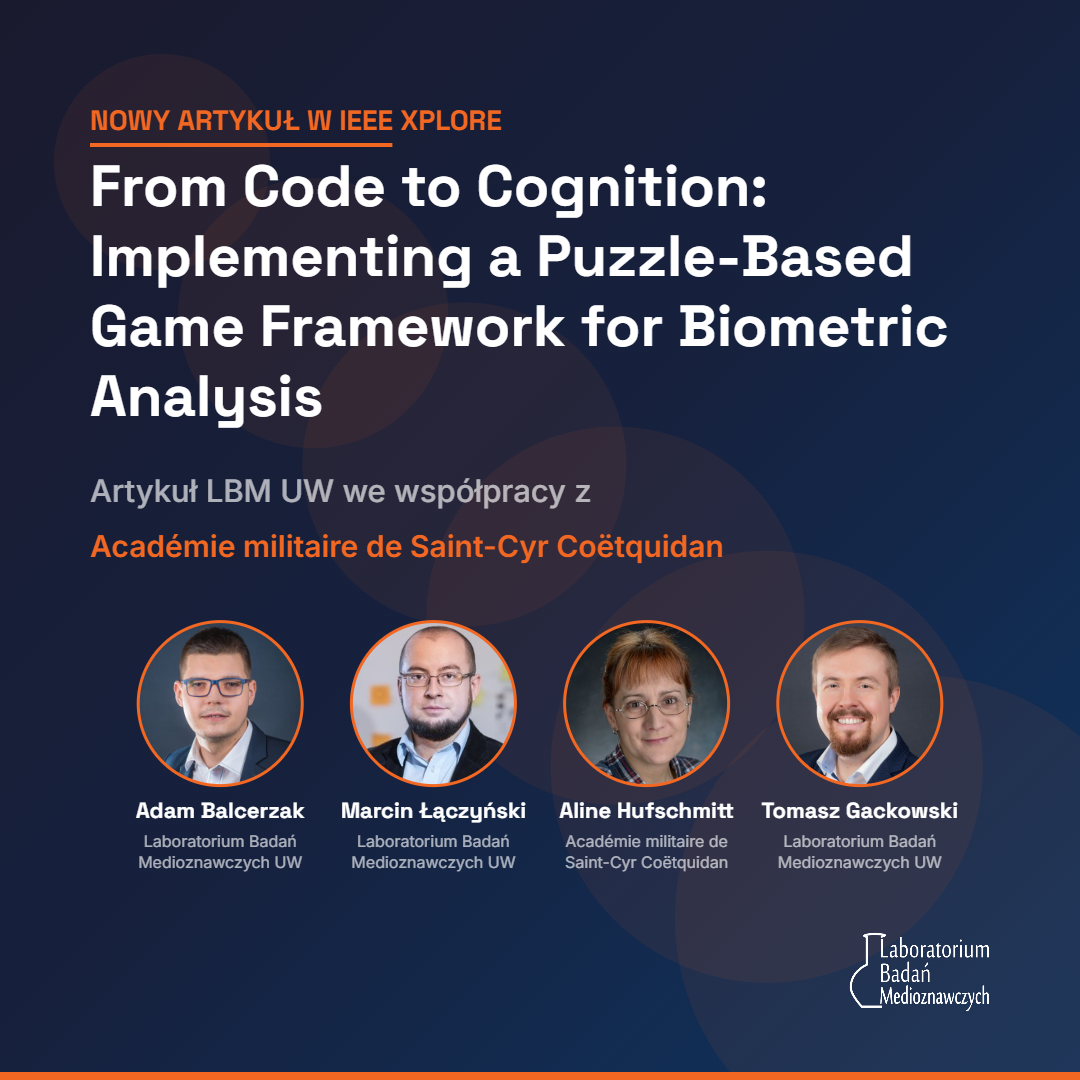
We are pleased to announce that a paper by Adam Balcerzak, Marcin Łączyński, Aline Hufschmitt, and Tomasz Gackowski has been published in IEEE Xplore.
From Code to Cognition: Implementing a Puzzle-Based Game Framework for Biometric Analysis
https://doi.org/10.1109/ACDSA67686.2026.11468237
The publication follows a presentation delivered at ACDSA 2026 – International Conference on Artificial Intelligence, Computer, Data Sciences and Applications, held on February 5–7, 2026, in Boracay, Philippines under IEEE patronage.