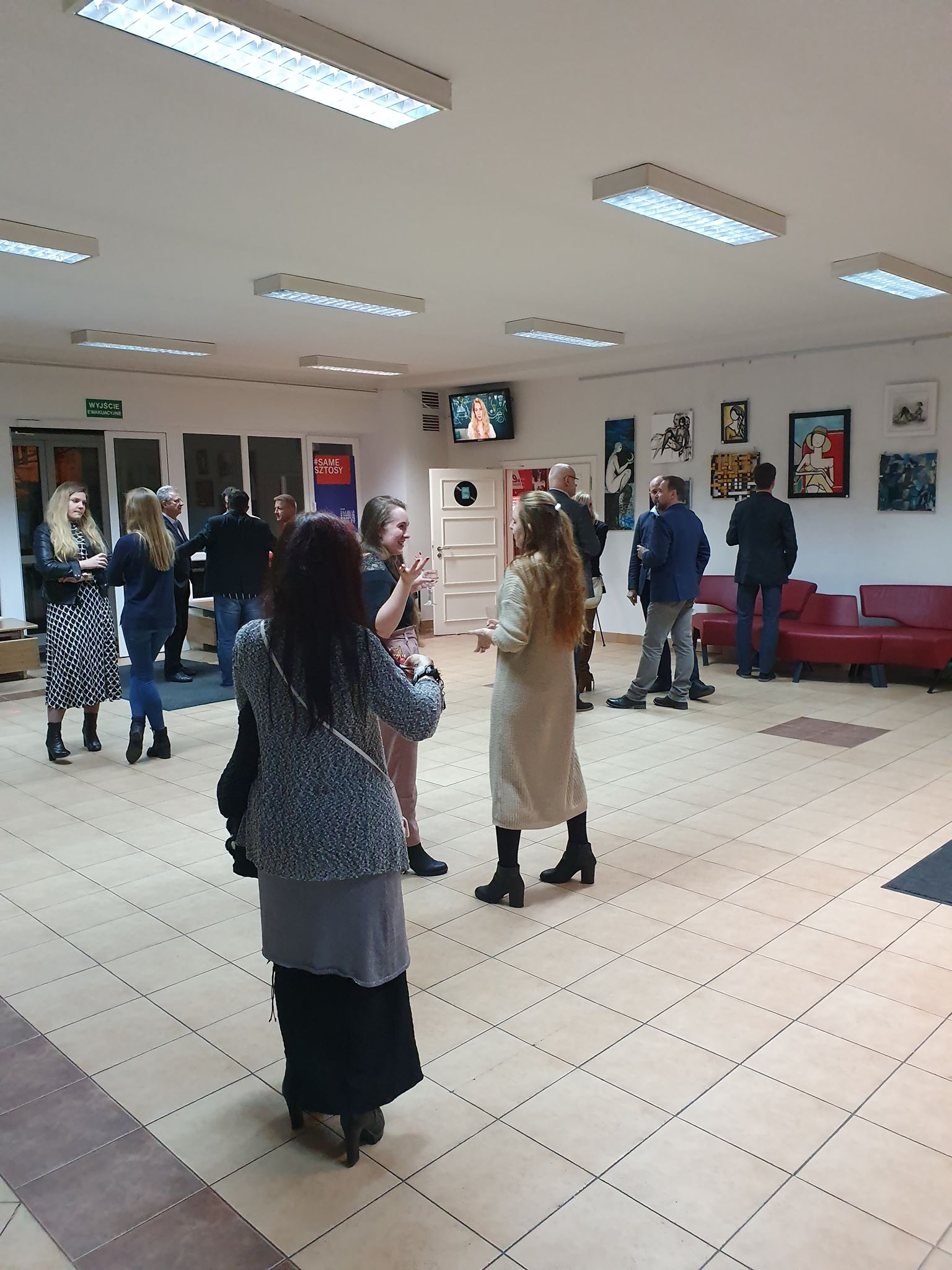
On 26th of November 2019, at 5 pm, the Faculty of Journalism, Information and Book Studies at University of Warsaw hosted an opening of paintings by Ms Barbara Dybala entitled "Modern Woman". The exhibition was organised by Laboratory of Media Studies. The event was opened by prof. Janusz Adamowski, Dean of the Faculty of Journalism, Information and Book Studies and dr Tomasz Gackowski, Head of Laboratory of Media Studies. The paintings will be presented in the foyer of the former building Łaźnia Majewska (2/4 Bednarska Street, Warsaw) until the end of 2019. Below you will find a keynote text by the author of the works, a short description of each painting and a biography. Further on, we also include a word of introduction to the exhibition given by Jacek Wasilewski, PhD, during the vernissage. We invite you to the exhibition.
CONTEMPORARY WOMAN
Women are the theme of my exhibition.
Women bring life, love, they are strong, stronger than men, even though they are usually called the weaker sex. Women are delicate but also valiant, brave and weak. Certainly, most of them fight for their families, but also for their freedom, their independence. There are those who will disappear, dissolve into oblivion and those who will be left with a colourful patch of love. Ageing is a natural stage in the life of every person. To be beautiful is, first and foremost, to feel beautiful, to accept yourself as you are, with all your faults and virtues.
For centuries, women have been kind of in the shadows, constantly fighting for their subjectivity, their own strong self. It seems to us that nowadays there has been a far-reaching change - emancipation. However, this is not the case. Women are free, they have rights, they can make decisions, they have choices. However, looking into the mirror of contemporary culture, are we women really in complete control of ourselves, our bodies, our lives and our souls?
I present 10 paintings, chosen specifically to show the world of women through my eyes, the eyes of an artist. Each painting has an individual description and a memento.
Barbara Dybała
CHARAKTERYSTYKA ARTYSTKI
Barbara Dybała.
A few words about me and my paintings.
I was born in 1981 in Świebodzice, Poland. I am a self-taught artist. I have had two exhibitions: in Szklarska Poreba and Krzeszów. My paintings are diverse, I use many techniques, styles, which are the fruit of my many years of experimentation. The recipients of my paintings are taken on a journey, from surrealism through expressionism to cubism. It is said that our words speak for us. It is very important to me that my works not only delight but also "tell" the world around us. Paintings can be a sense, a context, a narrative that can take us inside any phenomenon to get to know its true meaning and feel its essence.
Everything is an inspiration for me, every thing, every thought transforms into art. The sky, the cloud system, the moon, the sea, the sun (paintings such as: "Black Sun", "Thief of the Moon", "Buongiorno", "Sea") . Happiness, joy, sadness, grief or the experiences of others also inspire me ("Three stages of a woman"- painting sold to a private collector, "Metamorphosis", "Lebe,liebe verwirkliche Dich jetzt...", "loneliness is a choice and a lifestyle"). Ah, the beautiful song "in my secret life" by L. Cohen - these words, this video clip is already transforming in my head, taking shape to create a new painting through my hands ("in my secret life" - also sold to a private collector).
DESCRIPTIONS OF THE PAINTINGS
1. "Sally''. Size 30-40 cm, oil paint on recycled canvas. It is a portrait of a young girl, in the colours of the sun. Obstacles, challenges. The sacrifices she has to make to get to the top.

2. 'Rules of the boss'. Size 40-50 cm, made from strips of wood and an old frame. I was inspired by the game of chess, which has strict rules. In my painting the board is irregular, with breaks, folds and imprecise places. In this way, I wanted to show that in boss’ rules, there are really no rules. Except for one - as the boss says and wants, so be it. The boss is the boss and can do anything. A disadvantaged woman, discrimination, violence.

3. Warrior Woman, size 120-40 cm, oil painting on canvas. The painting depicts a woman dressed in the gold of glory. She has won the war. Strong and confident, she craves power. In her hand she holds a staff, it is her sword, age and experience. Ready for the next attack. I think every woman is a warrior for life. It's not about war directly, it's about the daily struggle with various problems, oppositions that stand in the way of us women. The strength of women.

4.''Double face'', dimensions 50-50 cm. Painting made with oil paints on canvas. Each of us has a double face... This does not mean, however, that we are bad. It is simply a form of defence against the unknown. It is defended.
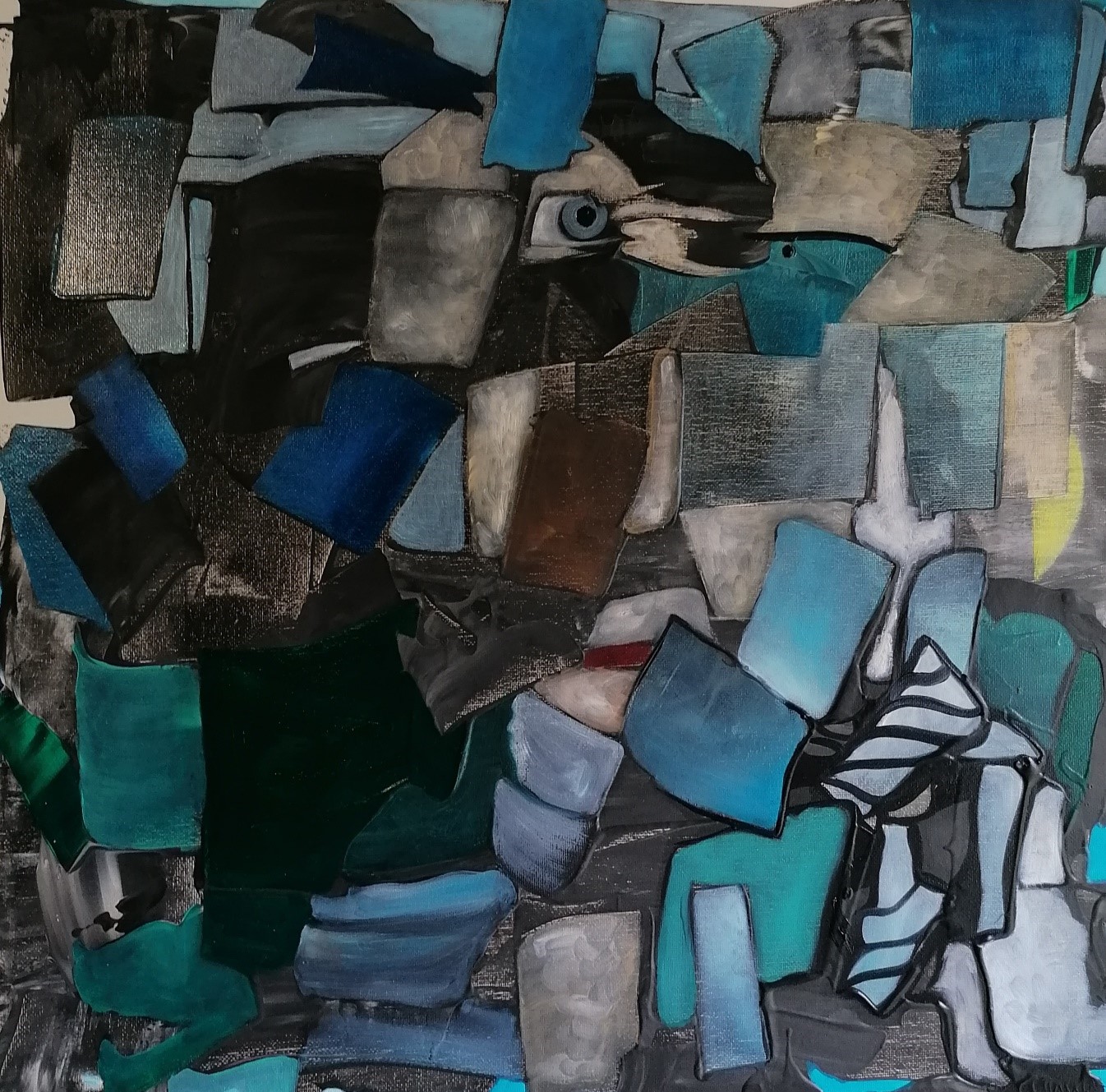
5. "Thief of the Moon" - dimensions 100cm-40cm, made with oil paintings on canvas. It all started with the legend of Mr Twardowski, to which I added a sequel... and this is how the painting "Thief of the Moon" came into being. One hundred years later, in a village on the other side of the world, a woman was born. She was ruthless. She wanted only one thing - to be always beautiful, young and immortal. For many years she tried to call the Devil to make a pact with him. However, he did not react at all. The furious manipulator decided to steal the moon together with Mr Twardowski. She wanted to take control of him and his powers, which he received from the Devil. When the Devil found out about this act, he decided to punish the woman. He tricked her into coming to the famous painter under the pretext of immortalising her beauty for eternity. When the painter put his final brushstroke on the canvas, the Devil uttered an incantation and imprisoned the woman in the painting entitled "The Moon Thief" - forever. Beauty at any price.
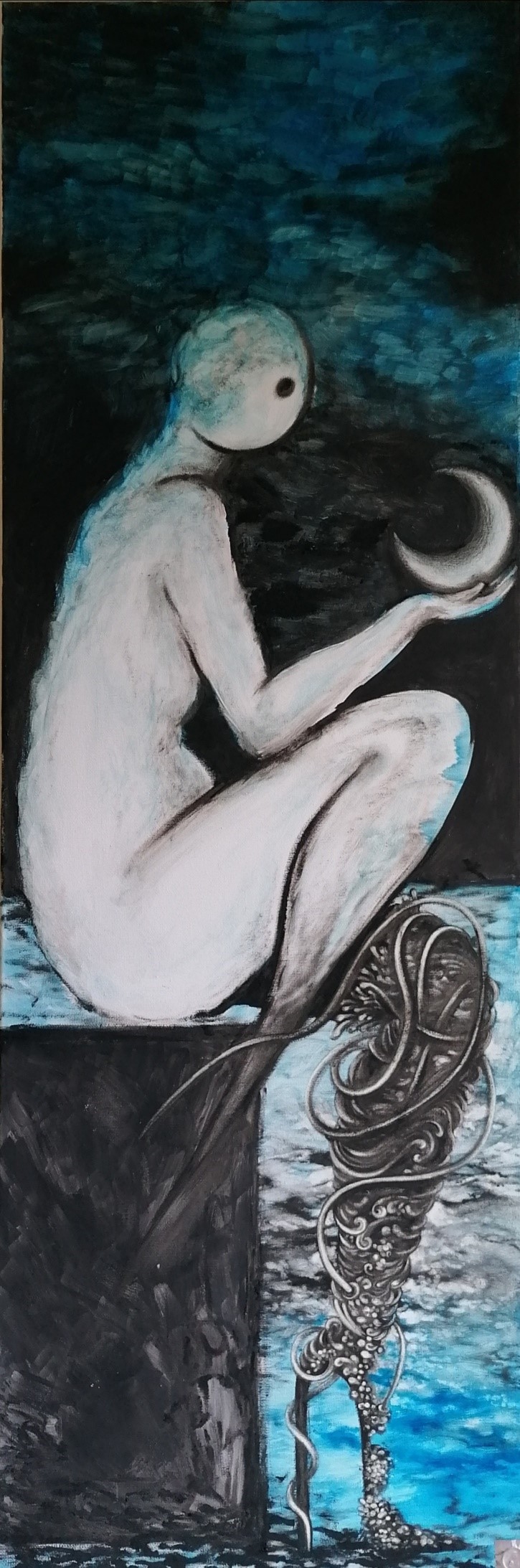
6. ''Metamorphosis'' - Dimensions 50-50 cm, painting made with oil paints on canvas. Inspiration is life itself, big or small things that can affect metamorphosis. And the most important thing is to start, to begin the transformation, to take the first step. A transformation, a figure without expression, without make-up, without ornaments, made of metal elements. A woman robot.

7. "Stop the hate" - Dimensions 50-50cm, made with oil paints on canvas. I was inspired to make this painting by the problem of today's times – hate speech. The painting depicts an imperfect woman who can be our mother, our grandmother, a friend, a neighbour, a lover. The most important thing is that she has feelings. She says stop the hate. No more psychological abuse of people who deviate from a certain norm. Ageing is a natural stage of life. Ageist violence.
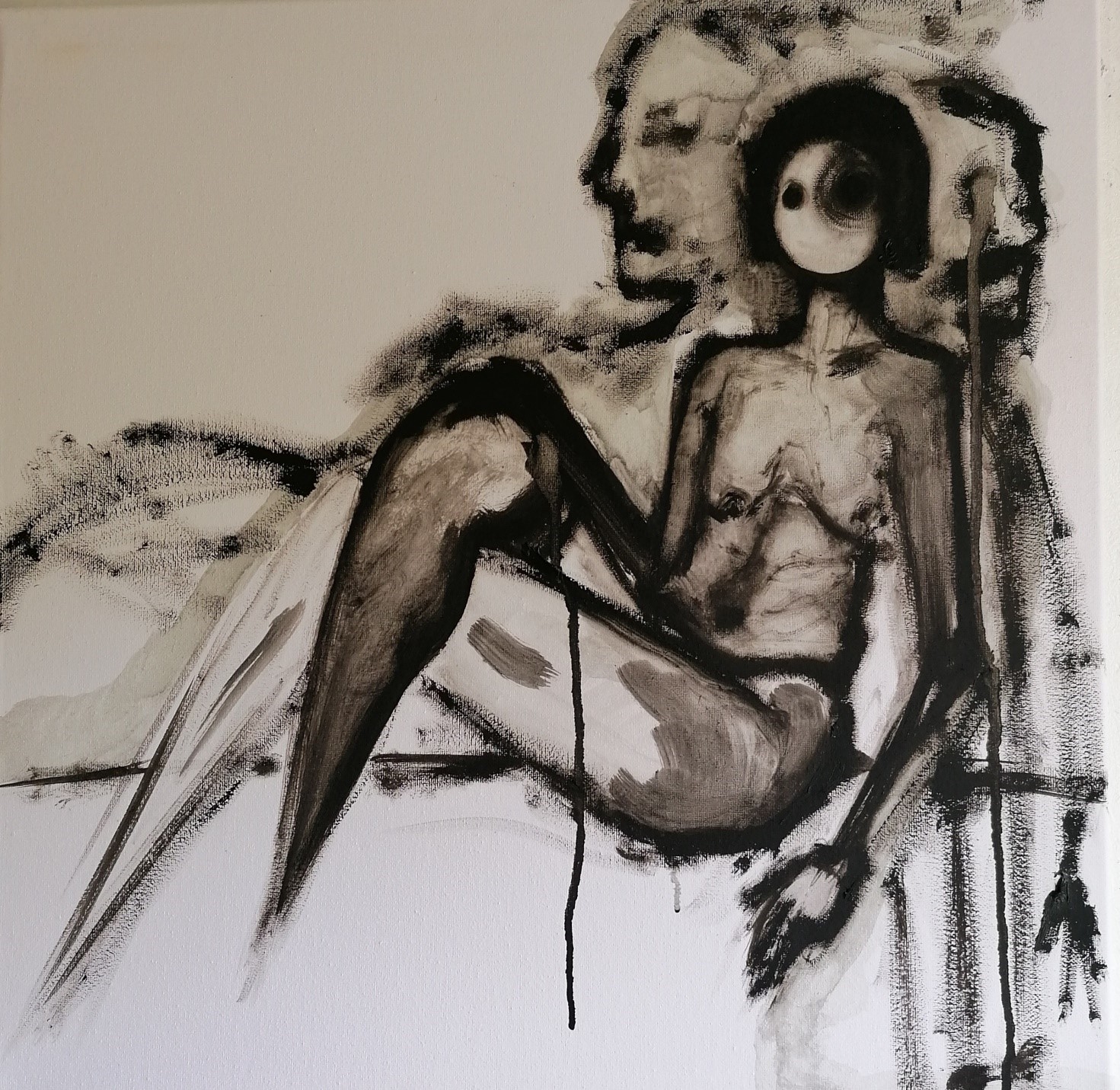
8. ''Lady in a hat'' - dimensions 50-70cm, oil paintings on sheet. Portrait of a woman sitting on an armchair. Wearing hat, yellow sun dress and akoya pearls. A woman satisfied, fulfilled, loved. I am the mistress of my body and my life.

9. ''Three stages of a woman'' - The painting is done in oil paintings on canvas, dimensions 140-65 cm, it is in a wooden frame. The painting refers to the three stages in a woman's life - a young woman, a woman in the prime of life and a woman in puberty.

10. ''Cubist'' - Oil paintings on canvas, dimensions 45-45 cm, the painting is in a wooden frame. It depicts a toxic woman from the future.

Foreword by prof. Jacek Wasilewski
Why an exhibition of paintings about women at the Faculty of Journalism, a word on how painting and media are connected.
1. In Antonioni's film “Enlargement” we see the adventures of a reporter who arrives at the truth - but arrives at this truth through art, or in the place of arriving at the truth his work comes into contact with art. It is the paintings of a friend that inspire him; it is these paintings that cause the reporter to change to a different perspective, to see the causal links that reveal the murder. But then - when enlarged - his picture is no different from the picture of his friend-artist, it contains the same quality of subjectivity. In the pursuit of truth, journalism and art are at one.
2. Journalism, like contemporary art, often reveals social change. After all, it was a newspaper report that inspired the redoubt of Ordon (although it turned out to be fake news), and Tamara Lempicka's self-portrait Tamara in a green Bugatti, today considered one of the typical art déco paintings, was originally intended for the cover of "Die Dame" magazine.
3. Although it is artists who change the norms of beauty, it is journalists who disseminate them. The new norm appears, for example, in the current covers of High Heels; but they would not exist without committed women's art, which deconstructs the norms of visibility and fights for a place for the woman not locked into the rigid corset of the stereotype.
4. There are several fronts in this struggle.
The first front is the fight for shape: for the shape of the body, for the limits of acceptability. This is what we can see in the difference between the image of Sally - based on roundness and sunny circles, and the Warrior, in which we can find pointy, plumpy, sharp lines.
Similarly, the image Stop the hate calls for the right to imperfection. Journalism - like art - brings into this area a call for the right to individualism. For acceptance. For sharp and pointed shapes to exist side by side with circles.
The second front is the fight for equal rules. This is the subject of the work Rules of the boss. It shows a world of rules that are illegible, full of kinks, with imprecise places that can be used against a woman.
In this area, journalism has a whole strand related to equal rights issues; it orbits around demands for social functioning in such a way that family life can be planned without standing on the slippery ground of sudden changes. We want to walk on a footbridge that is secure and doesn't have holes or is not treacherous - and in many places, especially on the issue of women's employment, we are facing this.
The third front of struggle is the right to hide. The right to privacy. In this privacy, women are often corrected, adjusted and positioned by those who 'know more and better'. As in the book How Men Explain the World to Me. The work Double Face talks about these situations. This is also what journalism has to contend with, on the margins of which a hive of paparazzi has grown, wanting to get at the real face of celebrities by force; a face that can only be for some, for those behind the scenes.
The fourth front of the battle is to show the often condemned black side of women as equivalent to male fascinations. When we look at Genghis Khan, Master Twardowski or other bold yet ruthless heroes, we tend to reserve a certain admiration for them. Women in ambitious roles lose their femininity. Women full of ambition, who have succumbed to such a stripping of stereotypical femininity as the heroines of the paintings Moon Thief or those who reject the typical display of femininity, like the female robot in Metamorphosis, do not have this admiration. Rather, we reserve awe and horror for them. This is where journalism, which feeds on scandals and stereotypes, has its homework to do.
The fifth and final front in the battle is the right to individual fulfilment. Fulfilment outside the community to which we are assigned. It is the freedom to be a troublemaker or a lady sitting on the beach in a red beach chair. That red as a backdrop from the painting of the lady in the hat tells us what is behind the heroine, what is past this idyllic beachcombing; it tells us about all the effort it takes to be someone fulfilled on the throne, without holding a child, a husband, a grandfather, a professor.
It's reminiscent of the best reports about women changing the world, as well as children's books like “Women. Explorers, champions, adventurers”. This is how one can imagine the uprisings or Mickiewicz's Grazyna when it is all over.
5. Artists and journalists are constantly trying to find the key to the other room, where there is a better world, or to open the curtains to reveal the angularity of the room we are currently nestled in. In these endeavours, journalists need artists, and artists need journalists. This is why we are happy that after journalistic photographs we can now look through Barbara Dybala's paintings.