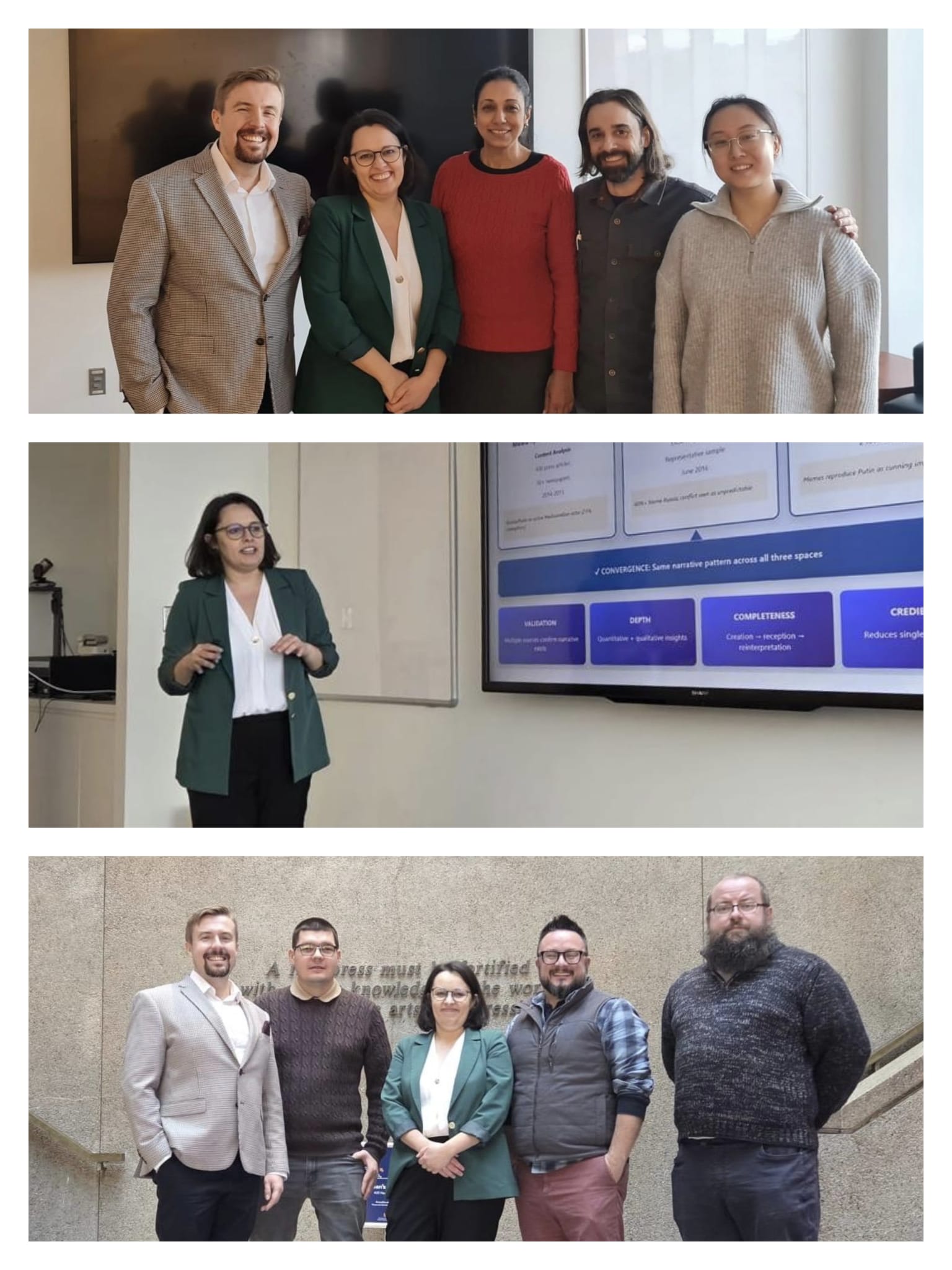
Between 19 and 24 January, a research visit by the team from the University of Warsaw’s Laboratory of Media Studies (LBM) took place at Syracuse University in the United States.
The visit was intensive and included meetings, lectures, and workshops. All activities shared one common goal: to develop better ways to describe and measure how people experience communication, technology, and narrative.
In the part devoted to political communication, Tomasz Gackowski and Karolina Brylska, serving as visiting professors, delivered a lecture with discussion and led a workshop designed specifically for doctoral students. The sessions focused on how emotions, a sense of authenticity, and the mechanisms of the spiral of silence shape public debate in Poland and the wider region, and on how these processes can be studied by combining different approaches and tools, including biometric methods. Doctoral students worked on their own research topics—such as polarization, the credibility of politicians, and AI-generated content—turning them into concrete project ideas and possible research strategies. The team extends particular thanks to Nick Bowman for the open and welcoming atmosphere that accompanied the meetings.
Another strand of the visit focused on immersive technologies and methods for studying user experience. The team visited the Extended Reality Lab at the Newhouse School and then presented its own research and development background—from VR and drone simulations to escape-room-style scenarios. During the session “From Engine to Emotion: Integrating Gameplay Analytics and Biometric Data in Unreal Engine,” led by Adam Balcerzak and Marcin Łączyński, the main focus was on linking in-game events with physiological responses such as eye movements, heart rate, and skin conductance. Reference was made to joint projects carried out with cadets from the Académie militaire de Saint-Cyr Coëtquidan, where synchronizing gameplay data with biometric measures enables a much deeper analysis of what truly happens “between the player and the game.” The meeting concluded with a very practical exchange of experience on technical and methodological challenges with T. Makana Chock and her team.
The final part of the visit included discussions with the Code^Shift Lab about shared interests and potential future collaboration, as well as a strong educational component linking game design with the climate crisis. Marcin Łączyński delivered a lecture and workshops presenting the CoAdapt project as an example of how games can translate complex knowledge about climate change into clear, narrative, and collaborative learning experiences—both digital and analog.