
We are pleased to announce the publication of three research papers authored by researchers from the Laboratory of Media Studies, University of Warsaw.
The publications cover three distinct research areas developed within the Laboratory.
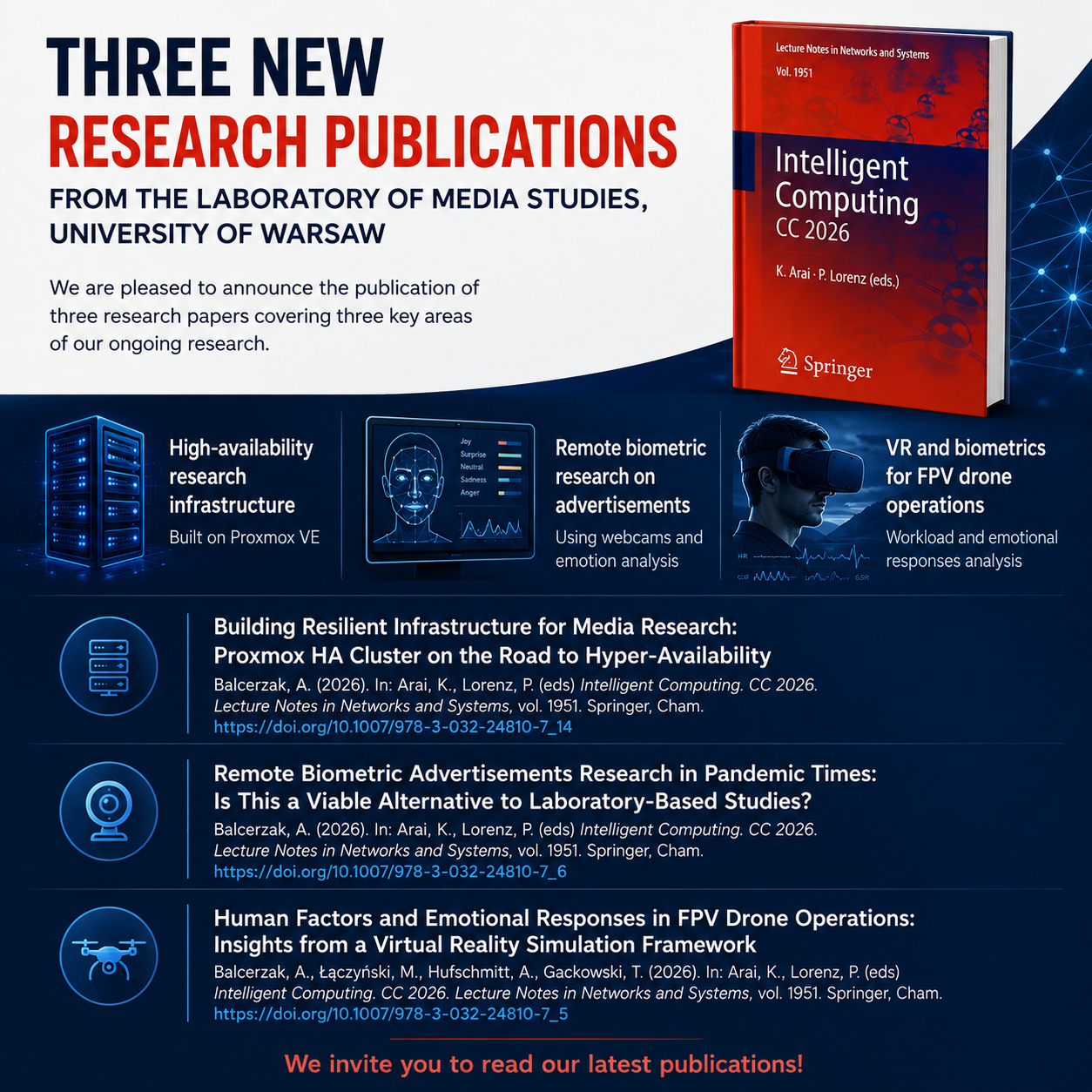
The first paper presents the design and implementation of a highly available research infrastructure based on Proxmox VE, focusing on solutions that ensure reliability, scalability, and continuity of research services.
The second paper examines the feasibility of conducting remote biometric studies on advertisement perception using webcams and emotion recognition technologies as an alternative to traditional laboratory-based experiments.
The third publication explores the use of virtual reality and multimodal biometric measurements to investigate the workload and emotional responses of FPV drone operators.
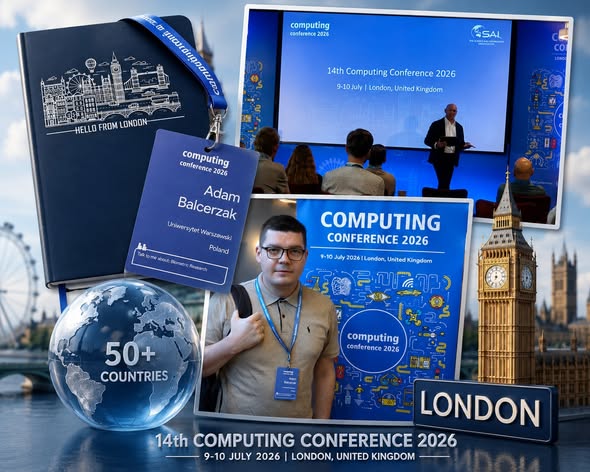
The Laboratory of Media Studies at the University of Warsaw (LBM UW), represented by Adam Balcerzak, has arrived at the 14th Computing Conference 2026 in London!
The conference brings together delegates from more than 50 countries, showcasing the latest advances in computing, artificial intelligence, and emerging technologies.

How does simple language build accessibility, safety, and trust?
In July 2026, "Poradnik Językowy" (Volume 834, No. 5 2026) published a report by a team of researchers led by Dr. Jacek Wasilewski.
The team examined how simple and understandable language affects the perception of texts by neuroatypical and neurotypical individuals.
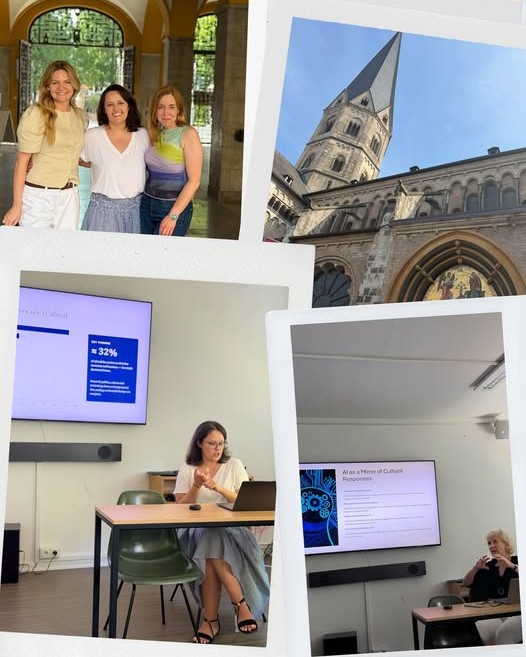
We have concluded another fruitful meeting within the project “Artificial Intelligence and Society - A Comparative Study. Opportunities, Threats, Attitudes and Practices of Media Users in Germany and Poland”, carried out in cooperation with the team of Professor Caja Thimm from the University of Bonn.
We discussed the latest batch of collected data. Karolina Brylska presented an analysis of media content on AI, Marlena Sztyber-Popko shared the results of a survey conducted among Polish users of genAI tools, and Anna Mierzecka presented insights from in-depth interviews with experts. We have also planned the structure of the post-project monograph and the scope of our joint presentation at this year’s ECREA conference in Brno.
The project is funded by the Polish National Agency for Academic Exchange and DAAD.